8. WHEN HISTORIANS GET MARRIED: HISTORICALLY-INSPIRED DRESS, HAIRSTYLE, AND JEWELRY ON MY WEDDING DAY

This post continues a short series about marriage traditions and my own adaptation of them for my wedding years ago. In the early posts, I identified a few defining characteristics of Vietnamese marriage patterns based on the existing research, including patrilocal residence, bride price, arranged marriages, ancestor worship, and the custom of betel chewing. I also explained how those characteristics are reflected in the two main marriage rituals today, the engagement ceremony and the wedding ceremony, and pointed to primary sources on these rituals from the seventeenth century. In the fourth, fifth, and sixth posts, I suggested ways that Vietnamese living outside of Vietnam can honor their heritage in their wedding celebration. In this post and the previous, I describe how I reinterpreted traditional marriage rituals for my own wedding.

I am a nerdy historian, and so I looked to history, including my family history, for inspiration as to what to wear on my wedding day. I knew that the “traditional” bridal outfit had evolved significantly over time, and I felt no compunction to conform to any particular style. Instead, I did some light research in my own family album and on the internet and chatted with the elderly ladies in my family to get a sense of the range of options.

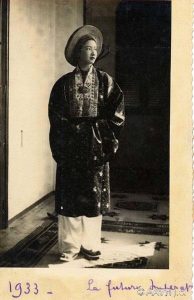
Empress Nam Phương, presumably on her wedding day, c. mid-1930s
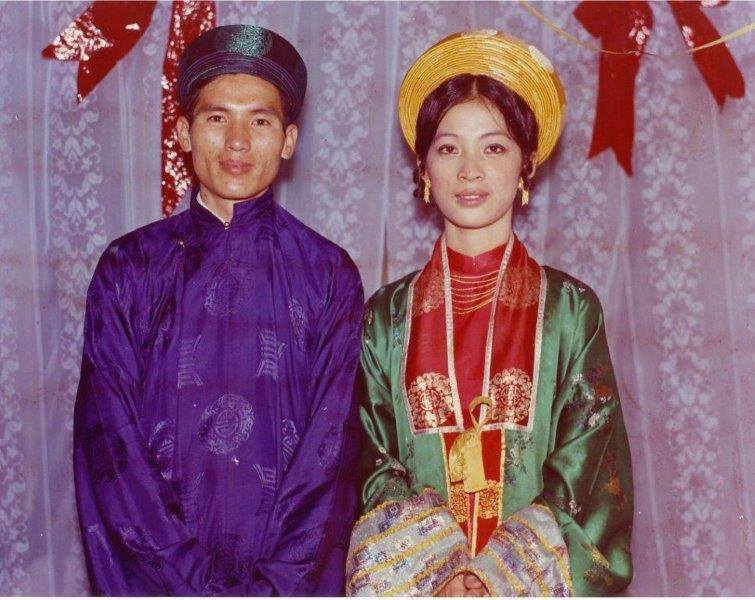
“Traditional” bridal ensemble, Saigon, 1975

WHAT’S TRADITIONAL?

Most Vietnamese think of the traditional wedding dress for women as the áo dài, a long tunic slit on both sides and worn over loose pants. The garment is now considered the Vietnamese national dress, though the modern version did not emerge until the 1930s or later, depending on how you define “modern.”1 Most Vietnamese would also add that the traditional bridaloutfithas two additional elements: an áo mệnh phụ, a long matching cardigan with wide sleeves to be worn over the áo dài, and a khăn vành dây, a large, stiff turban worn on the head like a crown. This ensemble borrows from the (non-bridal) imperial dress of royal women of the Nguyễn dynasty, Vietnam’s last dynasty, and was undoubtedly influenced by royal weddings and the nuptials of other members of the imperial court. Above left is Vietnam’s last empress, Empress Nam Phương, in a turban and a formal version of the áo mệnh phụ called the áo Nhật Bình. This imperial-inspired ensemble had become the conventional bridal outfit in Saigon and other major cities in the Republic of Vietnam (South Vietnam) by the late 1960s and 1970s, as seen in the photo, above right, of a bride wearing a bright yellow turban paired with a multicolored cardigan over a red áo dài.

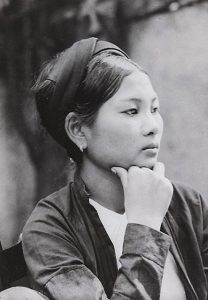
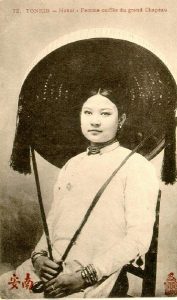
Yet the imperial-inspired bridal outfit wasn’t always considered traditional. In Toan Ánh’s Nếp cũ con người Việt Nam (The Old Ways of the Vietnamese), published in Saigon for the first time in about 1965, he remembered that rural northern brides in the decades before WWII wore an áo ngũ thân (“five-paneled tunic”)Toan Ánh also noted that brides pulled their hair into a ponytail, wrapped it in a black velvet scarf, and roped their velvet-covered ponytail around the crown of their heads. This style was often referred to simply as vấn khăn (“to wrap with a scarf”). During the procession, brides and other ladies also wore large, flat palm hats known as a nón ba tầm or nón quai thao to protect them from the sun.2 Perhaps these two images below are a good illustration of what Toan Ánh had in mind:

Northern women’s hairstyle, wrapped in a scarf, c. 1910s?
Northern-style flat palm hat, c. 1900-1910s

HONORING MY NORTHERN HERITAGE THROUGH A HISTORICAL HAIRSTYLE

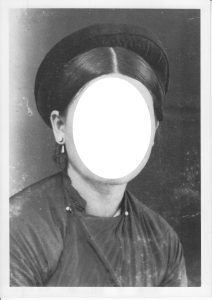
My family album backs up Toan Ánh’s memory. My grandmother grew up in rural northern and married my grandfather in the late 1930s, and her wedding photo shows her wearing the five-paneled áo ngũ thân with her hair wrapped in a black scarf around the crown of her head, just as Toan Ánh described. This picture of my grandmother inspired me to find ways to honor my specifically northern heritage rather than wear the conventional bridal ensemble, which is associated with the old imperial capital of Huế in central Vietnam. After all, I am not descended from royalty and don’t have any heritage connections to Huế.

My grandmother on her wedding day, northern Vietnam, late 1930s (face whited out for privacy)

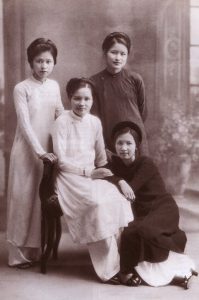
I was especially enamored of the hairstyle of young Hanoi women in the 1930s and 1940s. Like their elders, these young woman continued to wrap their hair around their heads but without any fabric, a style often called vấn tóc trần (“to wrap one’s hair bare”), as seen in the photos below. I had no idea how to wrap my hair like that, but I printed out a few historical photos that I found on the internet to give to my hairstylist, including the one on the left below. I also spent two years growing out my hair so that it would be long enough to wrap around my head.

Fashionable northern ladies, with bare coiled hair (seated and standing) and scarf-wrapped hair (kneeling), c. late 1930s?
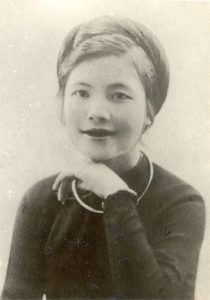
Northern woman, with bare coiled hair and a torque, c. 1930s? – so glamorous!

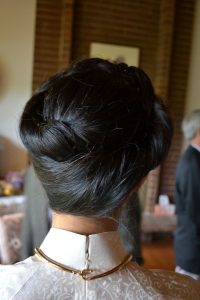
My hairstylist studied the photos and spent some time experimenting until she figured out how to recreate the bare hair wrap. She divided my hair in half into pigtails, each one just behind my ears, and twisted both halves. Then, she took the right pigtail, pulled it tight across the back of my head towards my left ear, continued wrapping it clockwise around the crown of my head, and pinned the ends behind my right ear where the pigtail originated. Conversely, she took the left pigtail, pulled it tight across the back of my head towards my right ear, continued wrapping it counterclockwise around the crown of my head, and pinned the ends in place behind my left ear, where that pigtail originated. The two twists met just above my forehead, one crossing over the other, and nestled against each other.

My wedding hairstyle, viewed from the back

LOOKING TO SAIGON FOR A STYLISH, HISTORICAL ÁO DÀI

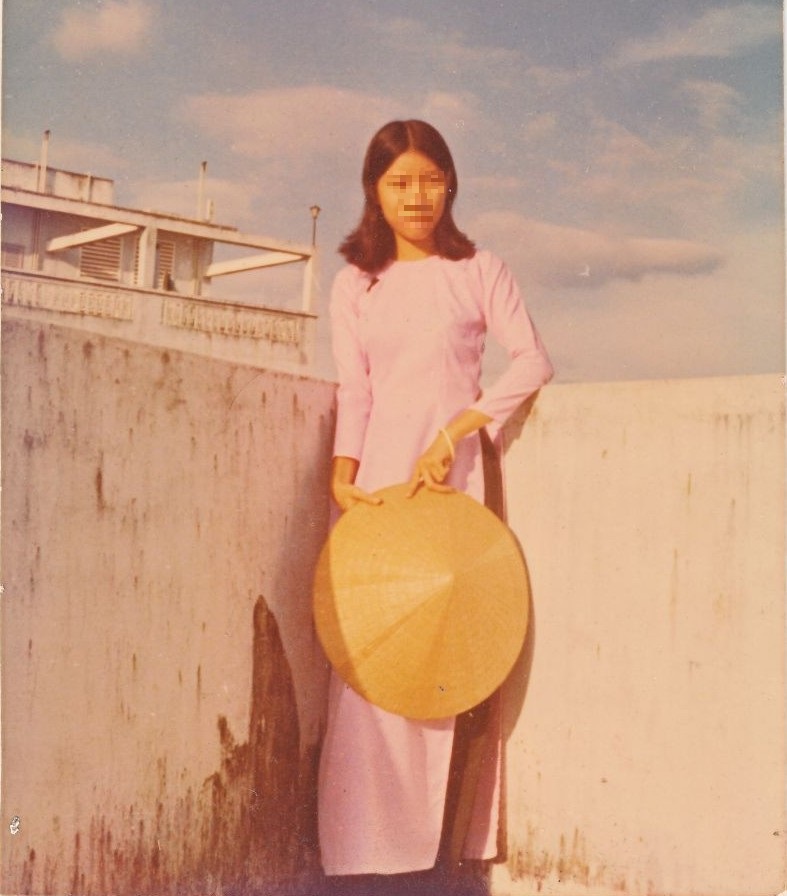
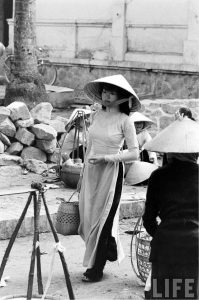
I am of mixed regional heritage, and I wanted to honor by Saigon roots as well. My mother was born and raised in the capital of the Republic of Vietnam (South Vietnam) in the 1960s and 1970s, and I have always loved the áo dài style of that era, with its high slits, fitted waist, elegant mandarin collar, and narrow, raglan-cut sleeves. The typical bridal color in Vietnamese culture is red and pink, but it’s not quite the strong cultural association that we have of white as a bridal color in the West. The photo of the left below shows my mom in a collar-less áo dài common in the 1970s, though not on her wedding day. The photo on the right shows an áo dài with a mandarin collar.

My mother in the early 1970s (face blurred for privacy)
A young woman in an áo dài, Huế, c. 1960s-1970s

I wanted to wear a kiềng, a Vietnamese-style torque often worn with the áo dài and popular in both northern and southern Vietnam throughout much of the 20th century. I especially liked the look of fashionable Hanoi ladies from the 1930s and 1940s, who paired their bare hair wrap with a kiềng, so that the torque framed their face and echoed the shape of their hairstyle. The portrait of the northern woman with her hair wrapped bare and sporting a torque is a good example.

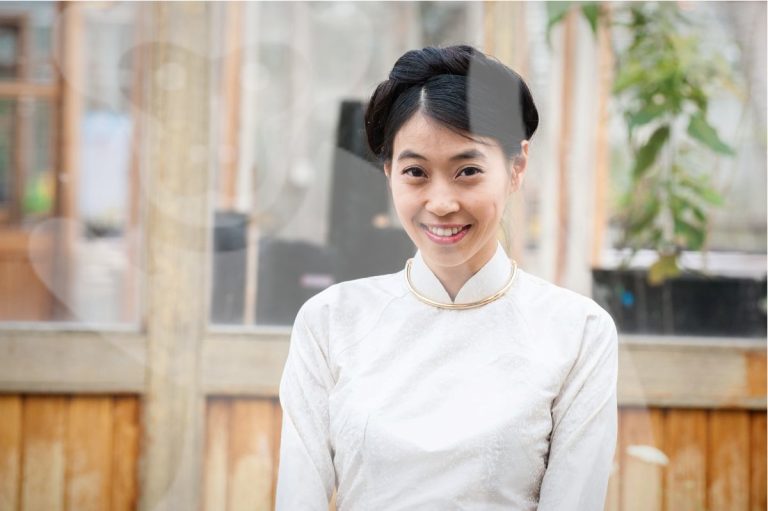
My husband and I were living in Bangladesh a year or two before our wedding, and we found some beautiful sari fabric that happened to be white. We chose it for my bridal áo dài. I wanted a more delicate kiềng than the torques that were then in fashion for Vietnamese brides, and I ended up buying a necklace that looked like a Vietnamese kiềng at JCrew. And voilà, I ended up with an outfit that borrowed historical styles from different eras and reflected my idiosyncratic taste.  My custom-made, 1970s-style áo dài was made with Bangladeshi fabric, a nod to both my Saigon roots and my year living in South Asia. My hair was wrapped in the bare style of fashionable Hanoi ladies in the 1930s and 1940s to honor my northern heritage. As the cherry on top, I sported an American necklace that was such a close dupe for a kiềng that many Vietnamese guests assumed that’s exactly what it was! And yet my look evoked something profound for my family and me. The first time my mother and cousin saw my hairstyle that morning, they gasped in recognition. During the reception that night, an uncle squeezed my shoulders and told me that he hadn’t seen anyone wear that style in decades, and it reminded him of when he was a little boy watching his mother wrap her hair in that exact same way. For me, too, it felt like I was wearing pieces of family’s past and Vietnamese fashion history on my very body.

My bridal look = northern hairstyle + Saigon áo dài + kiềng from JCrew

IMAGE CREDIT

Photo of Empress Nam Phương: https://laodong.vn/thoi-trang/di-vat-cua-hoang-hau-nam-phuong-tro-ve-viet-nam-1452400.ldo. The handwritten caption indicates that the photo is from 1933, but I believe she was actually married the following year.

Standard bridal ensemble: http://navygermany.gerussa.com/main/40%20Nam%20Dam%20Cuoi/KyNiem_40_NamNgayDamCuoi.htm. The original source provides the date and location.

Northern Vietnamese woman with coiled hair in a scarf: https://vi.wikipedia.org/wiki/T%E1%BA%ADp_tin:Tonkinoise.jpg. The date is is according to Wikipedia, but I have been unable to verify it.

Fashionable Hanoi ladies, with bare coiled hair and scarf-wrapped hair: https://en.wikipedia.org/wiki/%C3%81o_d%C3%A0i#/media/File:Jeunes_filles_de_Lemur_(2).jpg. The source indicates that this photo was published in Ngày Nay, a Hanoi-based journal, in 1938. I do not have access to Ngày Nay and am unable to verify this claim.

Northern woman, with bare coiled hair and a torque: https://vi.wikipedia.org/wiki/T%E1%BA%ADp_tin:Tr%E1%BB%8Bnh_Th%E1%BB%8B_%C4%90i%E1%BB%81n_(1912_-_1996).jpg. Internet sources claim that this portrait shows the entrepreneur, revolutionary, and loyal civil servant of the Democratic Republic of Vietnam (North Vietnam), Trịnh Thị Điền, in the 1930s. I have been unable to verify the date of the photo.

Northern-style flat palm hat: Nonbatam: https://en.wikipedia.org/wiki/Ba_t%E1%BA%A7m#/media/File:Tonkin_woman_3.jpg. I have not been able to positively identify the date of this colonial-era postcard, but similar postcards on the internet have a stamp from 1907 affixed to them.

South Vietnamese áo dài: https://huengaynay.vn/van-hoa-nghe-thuat/thong-tin-van-hoa/y-ao-nguoi-xua-47893.html. The source indicates that the photo was taken in Huế, and the style appears to be from the 1960s-1970s.

NOTES

The footnote function does not work on this post due to the software I am using.

1 For a fascinating discussion of a precursor to the áo dài and early debates on the national dress, see Martina Thucnhi Nguyen, On Our Own Strength (Honolulu: University of Hawaii Press, 2021), 79-114.

2 Toan Ánh, Nếp cũ con người Việt Nam: Phong tục cổ truyền (Saigon: Khai Trí, 1970), 172-177.
Leave a Comment

Your email address will not be published. Required fields are marked *