
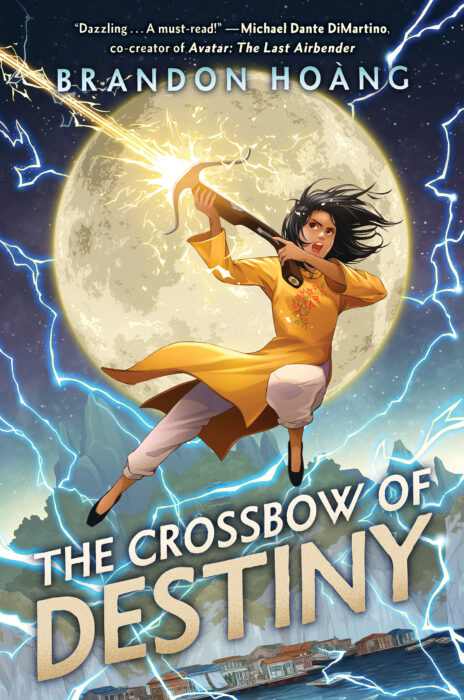
This summer, I put together a short packet of background reading on Brandon Hoang’s The Crossbow of Destiny for K-12 educators, and I am sharing a slightly revised version of that material here. The young adult novel is about a mixed-race Vietnamese-American girl who returns to her village in Vietnam after years of absence, and supernatural adventures await her. Much of The Crossbow of Destiny explores the Vietnamese-American identity of the main character. The novel also involves a creative retelling of traditional Vietnamese mythology. I am a historian of Vietnam rather than of Asian American history, and I don’t feel qualified to comment on the very American identitarian aspects of the novel. Instead, this post focuses on the textual, folkloric, and historical background that could help a teacher teach this book. This post assumes familiarity with the book, but if you haven’t read it, there are plenty of reviews and summaries on the internet. All references to the novel refer to the 2024 edition by Scholastic Press.
Brandon Hoang’s The Crossbow of Destiny is a popular young adult novel that draws extensively on Vietnamese mythology. It’s been well-received by readers, librarians, and educators alike.
Specifically, the novel interprets the semi-mythical, semi-historical figure, Thục Phán, also known as King An Dương. King An Dương occupies a key moment in the conventional Vietnamese historical narrative because he connects the mythic past and documented history.
According to mythology, the ancestors of the Vietnamese people were Lạc the Dragon Lord (Lạc Long Quân) and Âu Cơ. Âu Cơ bore a hundred eggs that hatched into a hundred sons, but the couple soon separated and split the children evenly between the two parents. Âu Cơ took her sons to live on land, while Lạc the Dragon Lord took his to the water kingdom where he was from. The sons that followed Âu Cơ chose one amongst them to be king, and this son established a line of kings called the Hùng kings. The clan name of these kings was Hồng Bàng, their dynasty lasted for eighteen generations, and they ruled over the kingdom of Văn Lang. The last of the eighteen Hùng kings had a beautiful daughter named Mỵ Nương. Two supernatural suitors, the Mountain Spirit and the Water Spirit, competed for her hand, and the Mountain Spirit won. The Crossbow of Destiny mentions the legend of the two spirits and Mỵ Nương in passing as the “The Legend of the Mountain Lord and the Sea Lord” (Hoang 92). There is no archaeological evidence of the Hùng kings or the kingdom of Văn Lang, and the earliest Chinese historical records about Vietnam do not mention them either.
The last Hùng king was overthrown by a man named Thục Phán (Ch. Shu Pan), and there is an elaborate myth explaining the rise and fall of Thục Phán’s kingdom. This myth is at the center of The Crossbow of Destiny. According to legend, Thục Phán conquered Văn Lang, took the title of King An Dương, and changed the name of the kingdom to Âu Lạc. King An Dương received divine assistance from the Golden Turtle (Kim Quy) and was able to build a spiral citadel called Cổ Loa (“Old Snail,” or Loa Thành, “Snail Citadel”) that served as as the capital of the kingdom. The Golden Turtle also provided the King with a magical crossbow to defend the kingdom. In some accounts, it was the engineer Cao Thông or Cao Lỗ who made the crossbow.
Was King An Dương and Âu Lạc real? Archaeologists have uncovered the remnants of an ancient citadel located in modern-day Cổ Loa, just northwest of Hanoi. The citadel was inhabited from the 5th or 6th century BC to the 2nd century AD. The site demonstrates the presence of a prehistoric state-level society in the Red River delta, but there is no evidence tying the archaeological site to the kingdom of Âu Lạc, and the name Cổ Loa did not emerge until much later. Some Chinese historical records do mention King An Dương, but there are few details. Most of the information about him is more legendary than historical and only appeared in Vietnamese historic records written centuries later. For all those reasons, King An Dương is regarded as a semi-mythical, semi-historical figure.
Legend has it that King An Dương was defeated by Zhao Tuo (Viet. Triệu Đà), ruler of the neighboring kingdom of Nanyue (Viet. Nam Việt). Zhao Tuo invaded Âu Lạc, but King An Dương used his magical crossbow to defeat the invaders. Then, Zhao Tuo asked for a truce and sent his son Zhongshi (Viet. Trọng Thủy) to marry King An Dương’s daughter, Mỵ Châu. Zhongshi went to Âu Lạc to live with his wife and secretly damaged or stole the magical crossbow, possibly with her help. He later reported the incident to Zhao Tuo and joined his father in attacking Âu Lạc. King An Dương was unable to fend off the invaders without the magical crossbow (or with only a damaged crossbow), and he fled the citadel to avoid capture. Some accounts claim that he took his daughter with him, and she wittingly or unwittingly betrayed him and alerted her husband Zhongshi of their whereabouts. The angry king killed his daughter, and the Golden Turtle led King An Dương into the sea to escape. Zhongshi grieved for his wife and committed suicide. Some accounts claim that the blood of Mỵ Châu flowed into the sea, and the oysters who imbibed her blood formed beautiful pearls. Zhongshi died by throwing himself in a well, and legend claims that the pearls found near her the place of her death will shine especially bright if washed in the well where Zhongshi died. Zhao Tuo expanded the territory of Nanyue to include the former fallen kingdom of Âu Lạc.
Zhao Tuo is considered the first historical figure in Vietnamese history. He is mentioned in Chinese historical records, and there is archaeological evidence of Nanyue. According to Chinese records, Zhao Tuo was a commanding officer that served the Chinese Qin dynasty (221-206 BC). When the Qin empire fragmented, Zhao Tuo decided to declare his own kingdom, Nanyue. Nanyue was located in what is now southeastern China and northern Vietnam, including the Red River delta. Nanyue endured for century until 111 BC when the Chinese Han dynasty (206 BC-220 AD) defeated Nanyue. Afterwards, Nanyue became the southernmost province of China, and the Red River delta in northern Vietnam remained part of the Chinese empire until 939 AD. Vietnamese people today refer to this a period as the “1000 Years of Northern Domination” (111 BC-939 AD). During this long period of Chinese rule, the Chinese empire referred to its southernmost province variously as Jiaozhou, Jiaozhi, and Annam.
Note that the story of King An Dương and Vietnam’s mythic past is conventionally associated with what is now southern China and northern Vietnam, especially the Red River delta. Not all historical records link the story to a specific location, but the ones that do point to places in that region. For example, records provide two conflicting locations for An Dương’s spiral citadel. The first is Bình Đạo, located in modern-day Bắc Ninh province, east of Hanoi. The second is Việt Thường, whose location cannot be determined with any confidence, but it is conventionally assumed to be in the region of modern-day Hà Tĩnh and Nghệ An provinces in north-central Vietnam. The records that claim that Zhongshi died by throwing himself in a well indicate that the well was at or near the citadel. The main location associated with King An Dương’s escape and the death of his daughter is Diễn Châu, which is conventionally assumed to be modern-day Diễn Châu in Nghệ An province.
However, The Crossbow of Destiny is set in central Vietnam, and Brandon Hoang emphasizes the specificity of this setting. The (presumably fictional) Vỏ Rùa Làng is a train ride from Ho Chi Minh City (Saigon) and a few hours from Đà Nẵng by motorbike. The Lỗ family runs a restaurant that specializes in bún chả cá, that is, noodle soup with fish cake, a dish that is a specialty of coastal south-central Vietnam. Several of the other dishes mentioned in the novel are also regional specialties. Most of the other places in the novel are real, including Marble Mountain (Viet. Ngũ Hành Sơn) in Đà Nẵng. Perhaps more importantly, Brandon Hoang grafts new details onto the story of King An Dương and relocates the site of the king’s family’s demise to a cave inside Marble Mountain. At one point, Freddie’s friend Duy even acknowledges that the site deviates greatly from the traditional location of Diễn Châu (Hoang 194). It is also worth noting that Duy is a descendant of King An Dương in the novel, and Duy’s family name is Phan, which in modern Vietnamese has a similar in pronunciation to Phán, the given name of King An Dương. Freddie’s family name is Lỗ, which is an uncommon family name among ethnic Vietnamese today, but it was the given name of the mythical engineer Cao Lỗ. The home village of the Lỗ family, Vỏ Rùa Làng (Turtle Shell Village), appears to be a reference to the Golden Turtle.
The setting of the novel is unusual for another reason as well. The story of King An Dương is found exclusively in Vietnamese and Chinese historical records and is not associated with any other historical or modern-day ethnic group, at least according to the existing research. But neither Vietnamese nor Chinese are indigenous to Đà Nẵng. In fact, all of lowland central Vietnam once belonged to the kingdom of Champa. Champa had its own culture and language that was influenced by Indian civilization and very different from both Vietnamese and Chinese culture. The Vietnamese kingdom of Đại Việt defeated and annexed Champa in the 15th century, and ethnic Vietnamese eventually migrated and settled there, displacing ethnic Chams from their native land. Unsurprisingly, the most important archaeological sites in the area around Đà Nẵng are associated with premodern Champa and the prehistoric Sa Huỳnh culture. If Freddie’s grandfather in The Crossbow of Destiny was an actual archaeologist and historian living in the region, and he conducted research about the ancient past in the Đà Nẵng area, then he probably would have studied non-Vietnamese peoples. After all, ethnic Vietnamese likely didn’t settle in that region in significant numbers until the 17th and 18th century. But the novel never mentions Champa, Cham myths, or any historic or archaeological site associated with region’s native inhabitants. Instead, Brandon Hoang’s novel relocates a specifically Vietnamese myth associated with prehistoric northern Vietnam to contemporary Đà Nẵng to give his mixed-race Vietnamese protagonist a chance to reconnect with her Vietnamese heritage. In so doing, The Crossbow of Destiny erases Champa and Cham people from the intervening history between the mythic past and contemporary Vietnam.
TECHNICAL STUFF
This post and the next is lightly revised from the material I compiled for the workshop, “Vietnam is Not a War,” organized by the Five College Center for East Asian Studies in Massachusetts.
Hoang, Brandon. The Crossbow of Destiny. New York: Scholastic Press, 2024.
Image credit: https://shop.scholastic.com/parent-ecommerce/books/the-crossbow-of-destiny-9781338789843.html