
This post continues a short series about marriage traditions and my own adaptation of them for my wedding years ago. In the first and second post, I identified a few defining characteristics of Vietnamese marriage patterns and explain how those characteristics are reflected in the marriage ritual, namely, the engagement ceremony and wedding ceremony. This post features a description of the marriage ritual from northern Vietnam in the seventeenth century.
Historians have traced the basic rituals and characteristics of Vietnamese weddings back to at least the 16th and 17th century. Some of our earliest sources of these practices come from Vietnamese Catholic converts and Westerners who lived in or visited Vietnam.
Bento Thiện, a Vietnamese Catholic convert, wrote a letter to a the Jesuit missionary in 1659 and appended to his letter a descriptive history of his country. The history is commonly known as the “History of Annam” (Lịch sử nước Annam) and was written in the Romanized script of Vietnamese, now known as quốc ngữ (“national script).1 This script, which uses the Roman alphabet, was invented by Western missionaries and became the modern script for vernacular Vietnamese in the 20th century.
The passage below from Bento Thiện’s “History of Annam” was translated by Nhung Tran in her book Familial Properties. It describes the inquiries and negotiations in the run-up to a marriage in northern Vietnam. Note that the young man’s family offers presents to the prospective bride, in keeping with the custom of bride price, and those gifts include areca nuts and betel leaves, as betel chewing was common in traditional Vietnam. Also note that after the two families agree to a marriage, the prospective groom must perform bride service during which he lives with and works for the bride’s family. Although Bento Thiện does not say as much, the prospective couple may have had a chance to at least see each other in passing and possibly speak to each other during this long engagement.
As for the ritual of taking a wife, first, the two sides must figure out if they are compatible. [If they are], then the boy’s family will visit [the girl’s family], bringing areca nuts and betel leaves so that the families can talk. If the girl’s family is willing co marry her away, then the boy’s family will immediately examine their ages and faces to see if they are auspicious; [if they are], then the boy’s family will ask [for the girl’s hand] again. If [the boy’s] family is rich, [then they will offer] a pig or a cow as [earnest] objects of trust…2
The boy goes to his wife’s father’s home to “be a son-in-law” for three years, so that the two families can examine each other’s intentions. If they are pleased and find each other gentle, then they both will agree with the marriage. Then [the two families] arrange a day and a cow or a pig [is offered] for the feast.3
I am especially charmed by the description of wedding rituals in another seventeenth-century work, A Description of the Kingdom of Tonqueen, an English-language work completed in 1685-1686 and published in 1732 about the early modern kingdom of Tonkin, located in modern-day northern and north-central Vietnam. The author Samuel Baron grew up in Hanoi as the son of a Vietnamese mother and a Dutch father who worked for the Dutch East India Company. The mixed-race Baron likely knew Vietnamese and was certainly familiar with local customs, and he later went on to work for the English East India Company.
In the passage below, he provides a similar description of the inquiries and negotiations. This is clearly an arranged marriage, and Baron explicitly states that people cannot marry without the consent of their parents. Again, it is the young man’s family that offers presents to the prospective bride. The young woman’s family only accepts the presents if they accept the proposal, and Baron points out that they find polite excuses if they do not. Interestingly, in Baron’s account, the engaged couple is not allowed to converse even after the engagement ceremony.
The Tonqueenese [the inhabitants of northern Vietnam] cannot marry without the consent of their father and mother, or of the nearest kindred. When a young man comes to the age of sixteen, eighteen, or twenty, his father and mother being resolved to get him a wife, make their application to the parents of the party they design for him, carrying with them an hundred dressed beetles [packets of areca nut and betel leaf smeared with lime paste], in a decent box, one jar of arrack [alcohol distilled from the sap of coconut flowers or sugar cane], or strong liquor, and a live hog; under favour of such a present only, this is to be proposed. The friends of the maid seeing the visitants thus prepar’d, and knowing by the custom of the country whereto it tends, give fitting answers to the question in hand, according to their inclinations; for if they are unwilling it should be a match, they find their subterfuges and excuses, by pretending their daughter’s youth and inability to take upon her the burthen of a household, and that, however, they will consider of the matter further hereafter, and the like compliments, wherewith they and their presents are sent back again.
But in the case they are content to bestow their daughter on the young man, the presents are readily accepted of, with expressions of their approbation of the business; and then immediately, without any other formality, they consult and agree about the most auspicious time (in which they are guided by their blind superstition) for the solemnization of the wedding: In the mean time the parents of the bridegroom send often presents of victuals to the bride, and visit her now and then yet the young people are not permitted so much as to speak to each other.4
Baron goes on to describe the wedding ceremony, and the paragraph below makes clear that the union is between two relatively well-off families. The groom offers precious metal and cash as a betrothal gifts the day before. On the wedding day, the bride’s family forms a procession as they proceed to the groom’s home, which will be her new residence, in accordance with the custom of patrilocal residence. As if to flaunt her family’s status, the bride wears gold jewelry, is followed by a gaggle of servants, and brings with her a substantial inheritance.
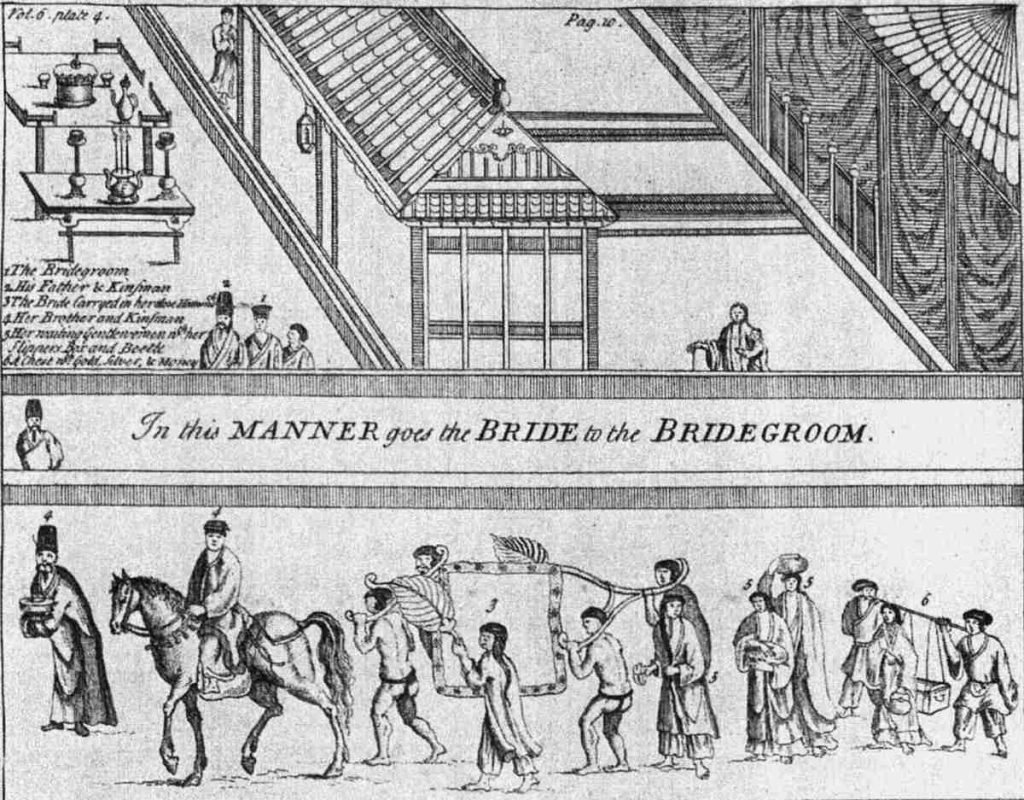
At the prefix’d time the wedding is kept, with a feast agreeable to the condition and abilities of the parents of the young couple, which doth not last above a day. The ceremony of the marriage is barely this: In the afternoon of the day that precedes the wedding, the bridegroom comes to the bride, and brings with him, according to his quality, either gold, silver, or a quantity of cash (the more the greater honour), and victuals prepared, all which he leaves there, and retires to his own home. The next morning being the wedding day, the bride is dress’d in her finest robes, with bracelets of gold, pendants, &c. her parents, acquaintance, and servants are ready to conduct and wait on her to the bridegroom’s, whither she goes about ten o’clock in the forenoon, with all this train attending her, whilst all her moveables, householdstuff, and whatever else her father and mother gave for her portion [that is, her inheritance], together with what she had of the bridegroom, is carried in great state; and for a more glorious shew, it passes a long field before her and the whole company, all which enter the bridegroom’s house, who receives her and them with kindness and courtesy, after their mode, and presents them with victuals prepared for the purpose, whilst musick and other expressions of joy, are not neglected: And this is the whole solemnity of the wedding, without any further formality of either magistrate or priest…5
Bento Thiện offers a slightly different description of the wedding, with particular emphasis on feasting, gifts from guests, and the bride’s inheritance.
Then [the two families] arrange a day, and a cow or a pig [is offered] for the feast of the girl’s family. Whether [the girl’s family] is rich or modest,the boy’s family will feast on the first day. An altar table is placed at the center, and if there are any guests at the wedding [such as] uncles and aunts [both older and younger than the groom’s parents], brothers, and sisters who have gifts, such as silver, money or silk, then they put it on the table. After that, the bride and groom come out and take a bow in front of the relatives. And on the following day, the girl’s family will feast, with singing girls’ performances to celebrate the wedding. And after that, the girl’s family will consult and determine an auspicious day to return the girl to the boy’s house – at that point, they prepare a dowry of arable land, silver, rice, water buffaloes, cows, chickens, pigs, and everything else so that she can return to her husband.6
What I like about Bento Thiện’s and Baron’s description of marriage customs is that it would be recognizable even to a 21st-century Vietnamese. Today, betel chewing has fallen out of fashion, but many marriages still include real or artificial areca nuts and betel leaves in deference to tradition. Most young people select their own spouses, but it’s common for parents to introduce their adult children to prospective spouses and for young people to want their parents’ approval. Even when the parents have played no role in the couple’s relationship, many couples choose to have a small engagement ceremony (lễ đính hôn or đám hỏi) with their immediate families as if it were the olden days of arranged marriage. Young men no longer perform bride service, but it’s culturally expected that a prospective groom may try to win over his bride’s family through gifts and by acts of helpfulness. Patrilocal residence is much less common, and fewer brides move in with their husband’s families than in the past, but a wedding (lễ thành hôn or đám cưới)is still understood to entail a visit by the groom and his family to the bride’s family’s home and a return visit of the bride and her family to the groom’s family’s home, now typically followed by a reception at a restaurant. So even as some customs have fallen away, people like to preserve the rituals that reflect defunct customs. I think it’s because those rituals help us feel connected to our forebears and give our celebrations that fun, distinctive, wedding-y character. In Western weddings, it’s often considered romantic for the father of the bride to give her away on her wedding day, even if the bride is financially independent from her parents and has been living with the groom for years. Similarly, many Vietnamese observe rituals that evoke customs they have no wish to practice because those those rituals feel festive, romantic, and traditional and tighten the bonds between couples and between their families.
Image credit: Illustration of a wedding ceremony in Samuel Baron’s A Description of the Kingdom of Tonqueen. In the illustration, the father of the groom (#2) and the groom (#1) in the top panel are at their home waiting for the arrival of the bride (carried in a hammock #3) and her family (#4) in the bottom panel. See Dror and Taylor, Views of Seventeenth Century Vietnam, 219.
- Nhung Tran, Familial Properties: Gender, State, and Society in Early Modern Vietnam, 1463-1778 (Honolulu: University of Hawaii Press, 2018), 17. ↩︎
- Tran, Familial Properties, 67-68. ↩︎
- Tran, Familial Properties, 69. ↩︎
- Olga Dror and KW Taylor, ed., Views of Seventeenth Century Vietnam: Christoforo Borri on Cochinchina and Samuel Barron on Tonkin (Ithaca, NY: Southeast Asia Program, Cornell University, 2006), 218. ↩︎
- Dror and Taylor, Views of Seventeenth Century Vietnam, 219. ↩︎
- Tran, Familial Properties, 69-70. ↩︎