
This post continues a short series about marriage traditions and my own adaptation of them for my wedding years ago. In my first two posts, I identified a few defining characteristics of Vietnamese marriage patterns based on the existing research, including patrilocal residence, bride price, arranged marriages, ancestor worship, and the custom of betel chewing. I also explained how those characteristics are reflected in the two main marriage rituals today, the engagement ceremony and the wedding ceremony, and pointed to primary sources on these rituals from the seventeenth century. In this post and the next, I suggest a couple of ways that Vietnamese living outside of Vietnam can honor their heritage on their wedding day.
A week before my cousin’s wedding, I received a phone call from a relative explaining that my cousin and his bride wanted to honor his Vietnamese heritage on his wedding day but wasn’t sure how. They were drowning in all the wedding preparations, and the last family wedding had been a while ago so no one in his immediate family could quite remember what to do. Could I help?
It was a joy to help him as both a cousin and a historian of Vietnam. I understood both the desire to honor one’s heritage and the uncertainty of how to do so. Like me, my cousin grew up in the diaspora far away from Vietnam. t takes extraordinary effort for a minority community to preserve its culture, and it’s natural to want to acknowledge that during a momentous occasion as a wedding. At the same time, many diasporic Vietnamese grew up with only limited exposure to Vietnamese culture. They simply haven’t attended enough Vietnamese weddings or seen enough movies with Vietnamese wedding scenes to have a model to follow or even multiple models to choose from. Moreover, most people get married only once or twice in their life, and it’s often through one’s own wedding that one learns wedding customs. As a result, many diasporic Vietnamese feel that the only way they can carry on their tradition is to recreate the exact same formula as a wedding they previously attended, even if they don’t understand the reason behind many of the elements they are copying. Or, in many cases, young couples hire a videographer and let the videographer direct their wedding.
But there are alternatives to mimicry or outsourcing. I think diasporic Vietnamese should feel entitled to adapt Vietnamese wedding traditions to suit their circumstances and needs and even to reinterpret those traditions for modern times. Honoring one’s tradition is not an all-or-nothing affair, and it’s perfectly acceptable to incorporate certain elements, ignore others, and then change some to make them work for you. Before receiving my relative’s call, I had spent a lot of time thinking about the traditional marriage ritual, both because I was teaching a new course on women’s history in Southeast Asia and because I got married a few years earlier. Below, I suggest five culturally-grounded, research-based ways that diasporic Vietnamese can honor their heritage on their wedding day.
1. ENGAGEMENT CEREMONY
The engagement ceremony takes place before the wedding ceremony and traditionally marks the start of the engagement. During the engagement ceremony, the groom and his family visits the bride and her family at their home to fix the date of the wedding and finalize the negotiations on the betrothal gifts (see #2 below). The bride family welcomes their guests with light refreshments or a light meal. Nowadays, most couples have to plan far in advance and might already have decided on a wedding date before the engagement ceremony. Nevertheless, if the two families do not live too far apart, it can be nice for the bride’s family to host a small, intimate party with couple’s immediate family members so the future in-laws can become better acquainted. Engagement ceremonies are formal events in that everyone is expected to wear nice clothes, but the food often consists of nothing more than tea and dessert.
2. BETROTHAL GIFTS FOR THE BRIDE’S FAMILY
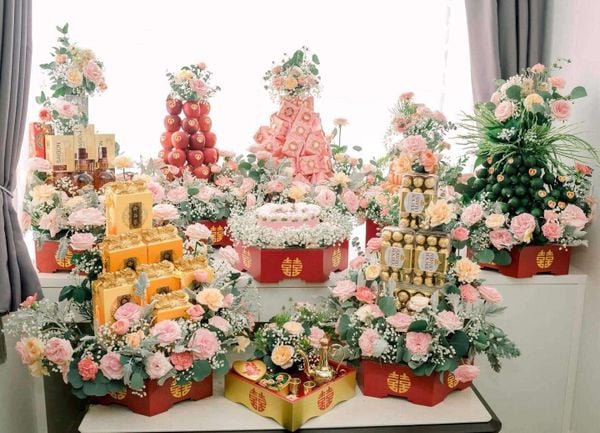
It is customary for the groom’s family to offer betrothal gifts to the bride’s family and bring those gifts directly to the latter’s home as part of the wedding ceremony. Betrothal gifts were traditionally negotiated in the advance, and the bride’s family might not proceed with the marriage if the groom’s family did not provide the agreed upon items. Historically, gifts included a range of items depending on the wealth of the two families, such as gold, silver, cash, silk, livestock, food, alcohol, and betel leaves and areca nuts. Today, betrothal gifts are more ceremonial than economically valuable, and you can carry on this tradition by asking the groom’s family to choose a few nice gifts for the bride’s family, such as wine, high quality coffee or tea, flower bouquets, fancy food gifts, or gift baskets. It would be especially heartfelt to give homemade baked goods, homemade jellies and jams, homebrewed beer, and homegrown fruits, flowers, or vegetables. In my opinion, the best betrothal gifts are easy to procure and have broad appeal similar to “hostess gifts.” Presents don’t need to be wrapped, but it is nice for them to be presented in an aesthetically pleasing way. When the groom and his family makes a grand entrance at the bride’s home with their cornucopia of food and presents, it gives the celebration a feeling of abundance and good cheer. Although the betrothal gifts are customarily delivered to the bride’s home on or before the wedding day, you could bring the gifts to the reception as a way to kick off the festivities.
As I mentioned in the first post in this series, betrothal gifts are a form of bride price. Researchers think the custom evolved as a way for the groom’s family to compensate the bride’s family for the loss of her labor when she leaves her family to move in with the groom’s. It also reflects the high value that a society placed on women’s labor. For that reason, I think it would violate the spirit of Vietnamese tradition to have the bride’s family offer betrothal gifts to the groom without any receiving any reciprocal gifts, as that would be a dowry rather than a bride price. But betrothal gifts can be adapted to be more like a gift exchange, especially for same sex couples. Both families can visit the other’s home with betrothal gifts or bring their gifts to the wedding venue.
3. ANCESTRAL RITES
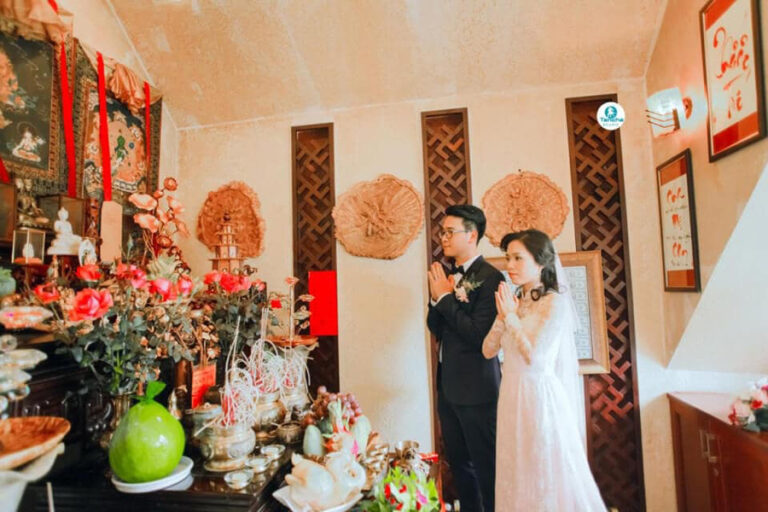
Vietnamese people traditionally worship their ancestors and make offerings of food, drink, and flowers to their deceased family members. Practitioners don’t necessarily believe that their ancestor’s spirits are still hanging around or that the offerings provide any sustenance to the deceased, but it’s a ritual of remembrance through which people express their love and respect for family members who are no longer with them. Ancestral rites are at the core of the wedding ceremony. Customarily, the families keep ancestral altars in or near their homes, and the bride and groom light incense and bow before the bride’s ancestral altar when his family delivers the betrothal gifts. Then, the bride and her family travel back to the groom’s home with him and his family, and the couple lights incense and bows before the groom’s ancestral altar. With these rites, the couple is paying respect to the lineages of both sides and informing their departed love ones that they are getting married. Ancestral rites are an extension of the year-round worship of ancestors (though ancestor worship has long fallen out of practice among some Vietnamese religious minorities). In my experience, non-Vietnamese spouses and their families who do not practice ancestor worship often find the practice very meaningful. At my wedding, my non-Vietnamese father- and mother-in-law both teared up talking about their parents just before the ancestral rite. At my cousin’s wedding, his wife’s uncle told me it was very sweet to see a portrait of the bride’s recently deceased grandmother on the altar because it meant that the grandmother could be part of her granddaughter’s wedding.
Ancestral rites can be as simple or as elaborate as you want. If either the bride or groom does not have an ancestral altar at their home, it’s easy to set one up. All you need is a table, some framed photos of the deceased family members you want to honor, incense, some sort of incense holder (such as a small cup filled with rice), and matches or a lighter. Arrange the framed photos in a row facing you, then place the incense holder in the middle in front of the photos. You can also get creative and add a few family heirlooms or mementos of your dead relatives. (NPR has some great ideas for an ancestral altar that is not culturally specific.) You also need a few plates to place on both sides of the incense holder and some fruit to place on the plates as an offering. Additionally or alternatively, you can opt for a few cups of tea or alcohol and/or a vase of flowers. You can also place the food, drink, and flowers given as betrothal gifts on the altar. To perform the ancestral rite, the bride and groom stand next to each other before the altar, light the incense, and place it in the incense holder. Then, the couple kneels and bows deeply three times. In many families, it’s typical for men to stand up between bows while women remain kneeling. Other families might choose only to light incense and do a few quick bows without kneeling. In my view, the thought matters more than the exact choreography. The lighting of incense and bowing are quiet, solemn moments, but you can talk all you want with your guests before and after. Once the incense burns out, you are permitted to remove the offerings and consume them.
The ancestral rites are customarily performed at the bride’s home and the groom’s home, and the couple traveled to both homes with their families on the same day or around the same time to perform the rites. Of course, that may not be practical depending on how far apart the two families live. You could opt to set up an altar to both families at the wedding venue or at one partner’s home and have the couple pay respects to their lineages simultaneously. Or, you might only perform the ancestral rite at the home of the Vietnamese partner. It’s typical for the ancestral rite to be reserved for close family members, but it’s also fine to do it at the reception so all of your guests can witness it.
4. “WELCOMING THE BRIDE”
In traditional times, young women left their family homes upon marriage, and the couple lived with or near the husband’s family in accordance with the custom of patrilocal residence. The traditional wedding ceremony served the practical function of bringing the bride back to the groom’s home. There’s even a special verb in Vietnamese for the action bringing the bride to the groom’s family’s home: rước dâu, meaning, “to welcome the bride” or “to escort the bride.” A more formal term is vu quy, meaning, “to go to one’s husband’s home,” though that term refers to the action of the bride relocating to her husband’s home. Because of the custom of “welcoming the bride,” the wedding ceremony begins with the groom and his family traveling to the bride’s family’s home, where the couple performs ancestral rites at her family altar, and ends with the bride and her family traveling to the groom’s family’s home, where the couple performs ancestral rites at his family altar. The groom’s procession to the bride’s family and the bride’s procession back to the groom’s home was the moment that both families showed off their wealth and status, as family members would have been in their best dress and carrying expensive gifts. After the wedding, the bride remains with the groom’s family as her family members return home.
In modern times, most couples choose to separate their wedding celebrations into two distinct events. First, “welcoming the bride” is reserved for close family members and usually takes place during the day. Both families wear formal clothes for the occasion, decorate their homes, and, if so desired, festively adorn their cars for the wedding procession. If the families live within driving distance, “welcoming the bride” and the ancestral rites can all take place within the same day. If the families live far apart, it might be necessary to visit their respective homes several days or weeks apart or to celebrate at the home of only one partner’s family. Second, there is a large reception at a restaurant or other wedding venue, with a much larger number of guests. Some couples choose to “welcome the bride” in the morning, then throw a big reception that evening, while others might “welcome the bride” months before the reception. In either case, having two events allows couples to both enjoy an intimate family party and throw a large bash with relatives and friends.
5. BETEL CHEWING
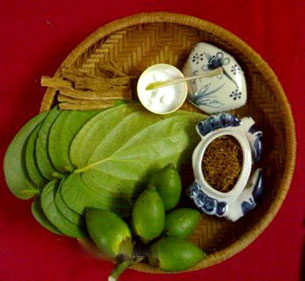
In Vietnam and much of Asia, it was traditional to chew the areca nut (trái cau, quả cau) with betel leaves (lá trầu)and slaked lime (vôi) as a mild stimulant, especially during social gatherings. Betel chewing (ăn trầu) is especially associated with weddings in Vietnamese culture. Although betel chewing has fallen out of practice, the areca nut and betel leaf continue to serve as symbols of martial commitment. For that reason, many couples purchase areca nuts and betel leaves to include among their betrothal gifts, even if none of their guests chew betel, or rent plastic ones. If neither of these options are appealing, there are other ways to incorporate areca nuts and betel leaves into your wedding. For example, wedding invitations could include pictures of betel vines and areca palms, or place cards indicating where a guest should sit could have a drawing of betel leaves and areca nuts in the corners as a decorative element.
IMAGE CREDITS
Betrothal gifts: https://flosa.vn/blogs/y-nghia-hoa/mam-qua-dam-hoi
Ancestral rites: https://asiana-plaza.com/le-gia-tien/
Areca nuts, betel leaves, and slaked lime: https://www.caidinh.com/trangluu1/khoahockythuat/traucau.htm