
Happy Mid-Autumn Festival! Chúc các bạn một mùa Trung Thu vui vẻ!
The holiday of Mid-Autumn Festival (Trung Thu, also known as Moon Festival in English) falls on the full moon of the eighth month of the lunar calendar, which is said to be the brightest full moon of the year. The eighth lunar month usually starts in early or mid-September of the Gregorian calendar, which is early fall and back-to-school time season in the US. Since the holiday originated in ancient China, I assume it must have actually taken place midway through the fall season there. But the name hardly matches the weather in tropical southern Vietnam, where it’s actually the tail end of the rainy season and doesn’t feel much like fall at all.
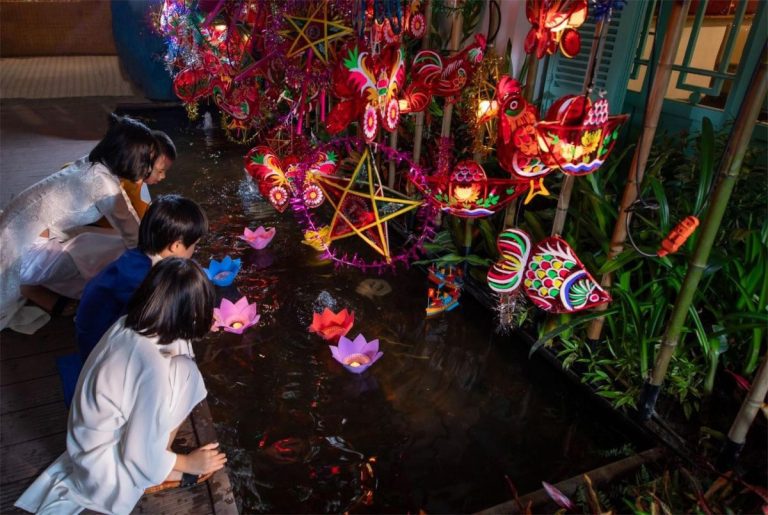
Whatever its origins, the Mid-Autumn Festival has become a children’s holiday in modern Vietnamese culture, and virtually all songs associated with the holiday are children’s songs. I grew up in the US, and my family always celebrated Mid-Autumn Festival when I was a child. One of my favorite holiday songs was the classic “Parade of Lanterns in the Eighth Month” by Đức Quỳnh, and I sang and listened to it every year when the holiday rolled around. The song is written mostly from the perspective of a little kid excited to parade around the streets with his/ her lantern and gorge on holiday treats.
It’s a custom for children to make or receive lanterns and then promenade with their lanterns ablaze on the night of Mid-Autumn Festival. The song describes the fun of walking around in the dark with a bunch of other children, all carrying lanterns of different colors and shapes. The child narrator even boasts that he or she will walk all over town.
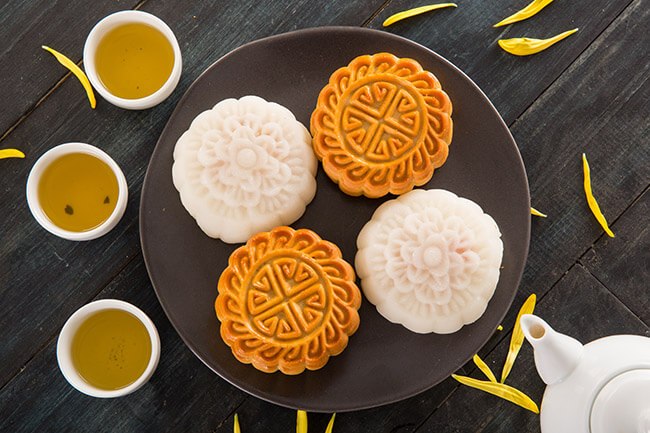
Another holiday custom is eating mooncakes and drinking tea while admiring the full moon. Vietnamese mooncakes, or bánh Trung Thu (“Mid-Autumn Festival cakes”), are large cakes that are molded into decorative designs. They come in two varieties: bánh nướng, or baked mooncakes with a soft shell made from wheat flour, and bánh dẻo, or no-bake mooncakes with a chewy shell made from glutinous flour (sticky rice flour). Mooncakes are traditionally filled with mung bean paste or lotus seed paste, and the nutty, sweet paste is balanced out by a crumbly, salted egg yolk placed at the very center to represent the moon. Non-Vietnamese friends tell me they find the texture of this filling similar to peanut butter. Another traditional filling is a mixture of nuts, seeds, and syrup, possibly with bits of pork sausage or candied winter melon thrown in, and has a texture that I would describe as somewhere between muesli and a granola bar. Mooncake is so sweet and rich that you usually only eat a few pieces in a given sitting, and even then it’s consumed alongside small cups of black tea so that the bitterness of the tea cuts the intense sweetness of the cake. The song describes both types of mooncakes as well as other sweet treats common during holiday gatherings, such candied ginger and candied winter melon. Another snack mentioned in the song is “melon seeds” (hạt dưa, or hột dưa, in the southern accent), which are usually roasted, unhulled pumpkin or squash seeds. Perhaps true to a child’s taste, the “Parade of Lanterns in the Eighth Month” makes no mention of bitter-tasting tea.
Most of all, Mid-Autumn Festival celebrates the bright, gentle beauty of the full moon, which is often personified in the figure of Hằng Nga. Hằng Nga (Ch. Chang’e) originated as a figure in Chinese mythology and was later adopted into Vietnamese culture. There are numerous stories about Hằng Nga. The story I remember learning as a child is that she was the wife of the heroic archer Hậu Nghệ (Ch. Hou Yi). Once upon a time, there were ten suns instead of one, and the heat of the ten suns scorched the earth and caused drought and misery for mankind. The brave Hậu Nghệ shot his arrow at nine of the suns and brought them all down, leaving only one to provide a comfortable amount of heat and light for humanity. But after his success, Hậu Nghệ became obsessed with eternal life and devoted himself to brewing an elixir that would make him immortal. His beautiful young wife Hằng Nga felt neglected. She also grew very curious about her husband’s secret and time-consuming hobby. So she decided to sneak into the room where he kept his elixir. But he returned unexpectedly, which threw Hằng Nga into a panic, and she drank the entire elixir in one desperate gulp. The potion was so powerful that it lifted her up into the air all the way to the moon and made her immortal, and Hằng Nga continues to live in the Moon Palace to this day. In Vietnamese culture, she is referred to affectionately and respectfully as Chị Hằng, or “Older Sister Hằng,” and often depicted as a sweet, beautiful young woman. Children’s songs often treat her like a kind, older sister who can be persuaded to play games, and the child-narrator of the “Parade of Lanterns in the Eighth Month” is eager to welcome her and willing to walk all the way to the Moon Palace.
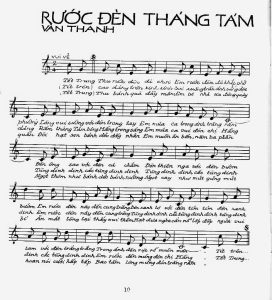
Little is known about the composer and songwriter Đức Quỳnh (real name: Nguyễn Đức Quỳnh?), who wrote this song under his alternative pseudonym Vân Thanh. Most websites describe his biography in brief contours: born in Hanoi, worked as a singer, migrated south in 1954 when Vietnam was partitioned, opened a music lounge in Saigon, composed a few songs, and was never very well-known. The “Parade of Lanterns in the Eighth Month” is undoubtedly his most famous, but I cannot find any reliable information on its date of composition. My guess is that it was first performed in the 1950s as it sounds like other songs from that time, at least to my untrained ear.
I liked this song as a child because it was fun and not didactic like some other Vietnamese children’s songs. But it also made me a little sad because it was so fun. The kids in the song seemed to have such a great time walking through the streets with their colorful lanterns. It made me jealous because I never got to do that! I grew up in the American suburbs where my sibling and I were often the only Vietnamese kids around, and barely any of my neighbors even knew it was a holiday. My family did attend celebrations in the city put on by the Vietnamese community, and the organizers often handed out free, Chinese-style paper lanterns for the children. But I wanted to parade down my street, lantern in hand, with other kids just like in the song! One year, I convinced my parents to let me light my lantern outside on our deck in the dark, but the wind was so strong that they were afraid I’d start a fire. Plus, it was just too cold to stay outside for very long.
Below is a recording by the children’s group Ban Nhạc Tuổi Xanh (literally, the “Green-Aged Band,” with green meaning “youth”) from about 1974 in Saigon. The band was directed by (the adult) Kiều Hạnh and often performed on the national television station of the Republic of Vietnam (South Vietnam).
RƯỚC ĐÈN THÁNG TÁM
Nhạc và lời của Đức Quỳnh
Tết Trung Thu rước đèn đi chơi
Em rước đèn đi khắp phố phường
Lòng vui sướng với đèn trong tay
Em múa ca trong ánh trăng rằm
Đèn ông sao với đèn cá trắm
Đèn thiên nga với đèn bướm bướm
Em rước đèn này đến cung trăng
Đèn xanh lơ với đèn tím tím
Đèn xanh lam với đèn trắng trắng
Trong ánh đèn rực rỡ muôn màu
Tít trên cao dáng tròn xinh xinh
Soi xuống trần ánh sáng dịu dàng
Rằm tháng Tám bóng Hằng trong sáng
Em múa ca vui đón chị Hằng
Tùng dinh dinh cắc tùng dinh dinh
Tùng dinh dinh cắc tùng dinh dinh
Em rước đèn này đến cung trăng
Tùng dinh dinh cắc tùng dinh dinh
Tùng dinh dinh cắc tùng dinh dinh
Em rước đèn mừng đón chị Hằng
Tết Trung Thu bánh quà đầy mâm
Em bé nhà ưa đứng quây quần
Đòi hạt sen bánh dẻo đầy nhân
Em muốn ăn bốn, năm ba phần
Ngọt thơm như bánh dẻo bánh nướng
Ngọt cay như mứt gừng mứt bí
Ăn mát lòng lại thấy vui thêm
Hạt dưa nghe cắn nổ lốp đốp
Người vui hoan nói cười hấp tấp
Bao tấm lòng mừng đón trăng rằm
PARADE OF LANTERNS IN THE EIGHTH MONTH
Music and lyrics by Đức Quỳnh
Original translation by Nu-Anh Tran
Let’s parade around with our lanterns on Mid-Autumn Festival!
I’ll carry my lantern all over town.
Happy with a lantern in my hand,
I’ll sing and dance in the light of the full moon.
Lanterns shaped like stars and fish,
Lanterns shaped like swans and butterflies,
I’ll carry my lantern all the way to the Moon Palace.
Lanterns in turquoise blue, purple ones too,
Lanterns in royal blue, white ones too,
Burning bright in every color.
High in the sky, round and sweet,
Shining gently onto the earth,
Sister Hằng beams bright on the full moon of the eighth month,
I’ll sing and dance to welcome her.
Boom boom chicka boom boom chicka,
Boom boom chicka boom boom chicka,
I’ll carry my lantern all the way to the Moon Palace.
Boom boom chicka boom boom chicka,
Boom boom chicka boom boom chicka,
I’ll carry my lantern to welcome Sister Hằng.
There’ll be trays of cakes and sweets on Mid-Autumn Festival,
The little ones like to gather ‘round,
Asking for lotus seeds and plump, chewy mooncakes.
I want to eat three, four, five pieces!
Sweet and fragrant like baked mooncakes and chewy mooncakes,
Sweet and spicy like candied ginger and candied melon,
Eating them is so soothing and [makes me] even happier.
Crunch crunch – as [we] munch on melon seeds,
Chatter chatter – as [we] excitedly laugh and talk,
Countless hearts are welcoming the full moon.
BEHIND THE TRANSLATION
The most difficult word in the song to translate is rước đèn. By itself, rước can mean “to escort,” “to welcome,” or “procession.” Rước đèn means for a group of people to walk around in public together while carrying a lantern, and the most accurate way to translate the phrase would be something like “to promenade with a lantern.” But no child would use the term “promenade.” So I have opted to use “to carry” and “to parade” for rước, depending on the context.
The other great challenge was to accurately capture the meaning while also preserving the artful syntax and alliteration. For example, the fourth and fifth lines of the second stanza read: “Lanterns in turquoise blue, purple ones too / Lanterns in royal blue, white ones too” (“Đèn xanh lơ với đèn tím tím / Đèn xanh lam với đèn trắng trắng”). A more literal translation would be: “Greenish-blue lanterns and purplish lanterns / Blue lanterns and whitish lanterns.” The original Vietnamese clearly describe lanterns in four distinct colors, not multi-colored turquoise and purple lanterns or blue and white ones. The two lines start with similar sounding words, xanh lơ (“greenish blue,” “cyan,” or “turquoise”) and xanh lam (“blue”), and I chose to specify that the second blue was “royal blue” to clearly differentiate it from the first while still repeating the word “blue” to mimic the original alliteration. In Vietnamese, when color words are repeated, it indicates that there’s a bit of that color, so tím means “purple,” and tim tím or tím tím means “purplish.” The two lines both end with repeated color words to indicate “purplish” and “whitish lanterns,” but those words sounds odd in English. Therefore, I rendered them simply “purple” and “white” but reworked the lines to create syntactical similarity. Taken together, the paired lines start with alliteration and end with parallelism to evoke a collection of lanterns that are similar but still varied. I tried my best to capture that in the translation.
There’s a somewhat related difficulty in the fourth and fifth lines of the last stanza, which read: “Crunch crunch – as [we] munch on melon seeds / Chatter chatter – as [we] excitedly laugh and talk” (“Hạt dưa nghe cắn nổ lốp đốp / Người vui hoan nói cười hấp tấp”). They translate literally as: “The crunching sound of biting down on melon seeds / People merrily and hastily talking and laughing.” Both lines end in alliterative words. Lốp đốp is an onomatopoeic word describing intermittent crackling or crunching noise and evokes the sound of people biting down on the hull to get to the edible seed inside. Hấp tấp means “hasty, rushed, or hurried.” Here, it describes people talking fast and imitates the sound of rapid speech. The original Vietnamese lines are atmospheric and do not indicate whether the child narrator is eating the melon seeds and talking or merely listening to the adults around him or her. I tried my best to capture the onomatopoeic character of these lines with crunch crunch and chatter chatter, but that forced me to depart from the original meaning a little bit.
In other cases, I had to deviate from the original get a more elegant or child-like translation. The first line of the second stanza specifies that the lantern is shaped like a grass carp (cá trắm), but I felt that the simpler word fish contrasts better with stars, swans, and butterflies and seems more child-like. In the fifth stanza, the children are demanding candied “lotus seeds and plump, chewy mooncakes” (“hạt sen bánh dẻo đầy nhân”). The original Vietnamese describes the chewy mooncakes as being “full of filling,” but that sounds more technical than appetizing in English, so I opted for plump to suggest that the cakes have a generous filling. I also simplified “Older Sister Hằng” to just “Sister Hằng,” as that sounds more like what a little kid would say in English. The original had virtually no punctuation, and I added some to aid comprehension.
Lastly, the fourth stanza of the song repeats a series of non-lexical vocables, that is, sounds that have no meaning. A common non-lexical vocable in English-language songs is fa la la la. In this case, the repeated line tùng dinh dinh cắc tùng dinh dinh seems to be an onomatopoeic reference to the sound of drums and gongs. Therefore, I chose boom boom chicka as an equivalent non-lexical vocablethat mimics drum beats and that is often found in English-language children’s music.
THE TECHNICAL STUFF
This song is such a classic that you can find the sheet music in numerous places on the internet. I had no idea which one is period sheet music, so I opted for one that appears to be from the same songbook that I had as a child.
Sheet music: https://truongca.com/nhac/4932-ruoc-den-thang-8-ruoc-den-thang-tam
Recording: https://www.youtube.com/watch?v=q_ckffmPN74
Image of mooncakes: https://hocmonviet.edu.vn/nguon-goc-va-y-nghia-cua-banh-trung-thu/
Image of lanterns: https://cafef.vn/mot-nha-hang-giua-ha-noi-so-huu-con-duong-long-den-dai-mien-man-100-truyen-thong-thanh-noi-pha-co-hap-dan-nhat-mua-trung-thu-188230919104906327.chn