
This post continues a short series about marriage traditions and my own adaptation of them for my wedding years ago. In the early posts, I identified a few defining characteristics of Vietnamese marriage patterns based on the existing research, including patrilocal residence, bride price, arranged marriages, ancestor worship, and the custom of betel chewing. I also explained how those characteristics are reflected in the two main marriage rituals today, the engagement ceremony and the wedding ceremony, and pointed to primary sources on these rituals from the seventeenth century. In the fourth, fifth, and sixth posts, I suggested ways that Vietnamese living outside of Vietnam can honor their heritage in their wedding celebration. In this post and the next, I describe how I reinterpreted traditional marriage rituals for my own wedding.
Like many Vietnamese, I wanted my wedding to honor my traditions. But I’m also a nerdy historian, and I wanted to do so in a culturally-grounded way that felt meaningful to me.
As I’ve written elsewhere, I grew up outside of Vietnam in the diaspora, and one of the peculiarities of passing down cultural ideas and practices in the diaspora was the narrowness of my exposure to Vietnamese culture, including marriage rituals. I do not remember attending any weddings as a child, Vietnamese or otherwise, in large part because so many of our relatives were still in Vietnam that there were very few family weddings. I grew up surrounded by American books, movies, and television that depicted American weddings, not Vietnamese ones. In fact, I largely learned about Vietnamese wedding rituals through my parents’ stories and their wedding album. My mom also discussed wedding traditions in the weekend Vietnamese-language class she taught in our home, and I sometimes read about weddings in Vietnamese-language novels. As a result, my conception of Vietnamese weddings was incredibly narrow. In contrast, I knew that Western weddings had infinite variations. Some weddings included a bouquet toss and a garter toss, but others didn’t. Guests at some receptions threw rice, but not at all. Some couples chose to have bridesmaids and groomsmen, but others didn’t. Even as a teenager, I understood that there was a repertoire of practices that Western couples could choose from, and most couples could feel like they were carrying on tradition without creating an exact replica of their parents’ wedding. But I simply didn’t have the same cultural knowledge about Vietnamese weddings until much later, after I became a researcher.
My personal experience is typical of growing up outside of Vietnam, and many young diasporic Vietnamese often feel like the only way to be Vietnamese is to blindly and uncomprehendingly mimic one’s parents. But I was determined to treat my wedding as my own interpretation and adaptation of tradition, just like I would have had I grown up as part of the cultural majority. And so I put on my historian’s brain to figure out how to do that.
(I did not have a traditional engagement ceremony because I was living overseas at the time, but my spouse and I had reception in Saigon so that my Vietnam-based relatives could attend. Therefore, this post is just about my wedding ceremony.)
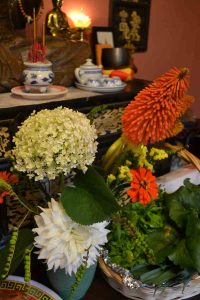
Many of the traditions I described in my previous posts are obsolete or simply not applicable to my situation. My grandparent’s marriage in the 1930s was the last arranged marriage in my family, and it never occurred to me or my parents that I would have one. Neither my husband nor I could find suitable jobs near either of our parents, so we couldn’t practice patrilocal residence even if we wanted to. And it’s been generations since anyone in my family chewed betel. But I still wanted my wedding ceremony to include other elements of the traditional marriage ritual, namely ancestral rites, betrothal gifts (that is, bride price), and a visit from the my husband’s family to bring me back to his parent’s home as a vestige of patrilocal residence. By that point, my parents had set aside a room in their house to be the worshipping room, where they kept the ancestral altar, incense, and other religious items. My husband’s family is not Vietnamese and do not worship their ancestors, but they willingly set up an ancestral altar for the occasion. My father- and mother-in-law turned their beautiful antique desk into a temporary altar, and they placed portraits of my husband’s grandparents on the desk along with a few heirlooms and other special items that had belonged to his grandparents. They also printed out name cards for every picture so that guests could identify each grandparent, which I thought was a neat idea.
BETROTHAL GIFTS, REINTERPRETED
Perhaps the most fun part of wedding planning was thinking about betrothal gifts, and fortunately, my husband and his family were game. As I described in the first post in this series, traditional betrothal gifts include areca nuts and betel leaves, but as the custom of betel chewing has fallen out of favor, many Vietnamese couples now choose to rent plastic replicas of areca nuts and betel leaves as a nod to tradition. Or, they manage to source real betel leaves and areca nuts but discard them afterwards because none of their guests chew betel. I’m not fond of plastic plants or wasting real plants, and I didn’t want to rent any props. More to the point, I wanted to capture the spirit of betel chewing rather than the physical form of areca and betel plants. In traditional times, the chewing of betel nut was a social lubricant and present at all gatherings. People chewed betel together during celebrations, including weddings, and offered it to guests the same way that modern people today might socialize over coffee, tea, or alcohol. In short, betel chewing was a symbol of conviviality and marital commitment in Vietnamese culture. So I suggested that my husband’s family swap out the betel and choose some nice wine instead.
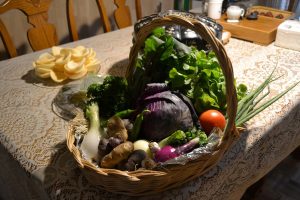
By the 20th century, betrothal gifts also included holiday foods such as sticky rice (xôi), a roast pig, egg rolls (chả giò or nem rán), pork loaf (chả lụa or giò lụa), and certain cakes. A long time ago, those dishes were holiday foods because they were expensive and took a lot of time to prepare, but they have become quite affordable in contemporary times and are no longer that special. Moreover, both of our families were semi-vegetarian, and few people wanted to eat pork loaf or roast pig. Nevertheless, I liked the idea of good food as a marker of a special occasion, and I suggested that my husband’s family choose food items that were heartfelt gifts that my parents might actually enjoy. Since my father- and mother-in-law are talented gardeners and bakers, I suggested a betrothal gift of homemade bread, homegrown flowers and vegetables, and maybe some fancy balsamic vinegar. On my wedding day, my husband, his parents, his aunts and uncles, his siblings and siblings-in-law, and his nieces showed up at my parents’ door, their arms laden with cabbages, onions, potatoes, peppers, tomatoes, tropical fruit, dahlias, hydrangea, red hot poker flowers, bread, wine, fancy vinegar, and jars of roasted bell peppers. Such betrothal gifts were better than fake areca nuts any day!
ANCESTRAL RITES: HERS AND HIS
The ancestral rite for my family took place in my parent’s worship room for the ancestral rites. My mother explained to our guests the names and relationship of each relative whose portrait was on our altar, and we placed the flowers, vegetables, tropical fruit, vinegar, and roasted red peppers on the altar as an offering. Then, my mother lit the incense and very respectfully informed the ancestors of our marriage. My parents kneeled and bowed in front of the altar, and then it was my husband and my turn to light incense, kneel, and bow. Afterwards, we returned to the dining room, and my husband and I poured tea for my parents and his parents and then everyone else as an expression of our gratitude. The night before, my father had decided on a whim to bake a quiche, so that was the decidedly untraditional, un-Vietnamese meal that we shared with our guests along with some nuts and cookies. Once the incense burned out, we all headed back to my husband’s parent’s house. My entourage included my parents, sibling and sibling-in-law, and aunts and uncles.
At my husband’s parent’s house, we performed the ancestral rite at the altar that his parents had set up in the living room. His parents explained to my family the names and relationship of each person whose portrait was on their altar and the meaning of the various heirlooms and mementos. They had decided that they would choose their parents’ favorite foods as offerings, and they announced and explained the significance of each food before placing it on the altar. As they talked about their deceased parents, my father- and mother-in-law got emotional and teared up. It was so sweet! Instead of lighting incense, my husband and I lit the candles on his family’s altar, as candles are more customary in his family. We then kneeled and bowed in front of his family’s altar, just like we had for mine, and his family then treated us to an informal meal. Thus concluded the traditional Vietnamese festivities. That night, we had a brief Western-style ceremony with my brother-in-law as an officiant and a formal reception at a local venue. Most of our guests had not been invited to the ancestral rites earlier that day, but we had a “heritage table” with photos of the deceased family members from both family altars. My husband and I spent our first night as a married couple at his parent’s place, which is also traditional. For many Westerners, spending one’s wedding night at the home of the groom’s parents rather than a hotel or the couple’s own home might seem unromantic, but for me and my family, it felt like I had been folded into his family circle.
As I recount it now, it sounds so easy and obvious, but at the time, it was a genuine intellectual exercise to isolate the aspects of tradition that mattered to me and reinterpret them in a way that felt natural and suitable to my life. At first, my parents thought I was absolutely nuts for suggesting my husband’s family set up an ancestral altar, but they too found it very touching to see my father- and mother-in-law tear up at the thought of their own parents. My parents loved my idea for the betrothal gifts, as they do not have green thumbs, and they marveled at the flowers and vegetables from my mother- and father-in-law’s garden. For me, my wedding day captured the spirit of the traditional Vietnamese wedding – its hominess, festiveness, and reverence for ancestors – rather than just the outward form, and it felt natural instead of rehearsed. Plus, my father enjoyed that balsamic vinegar for weeks afterwards!