
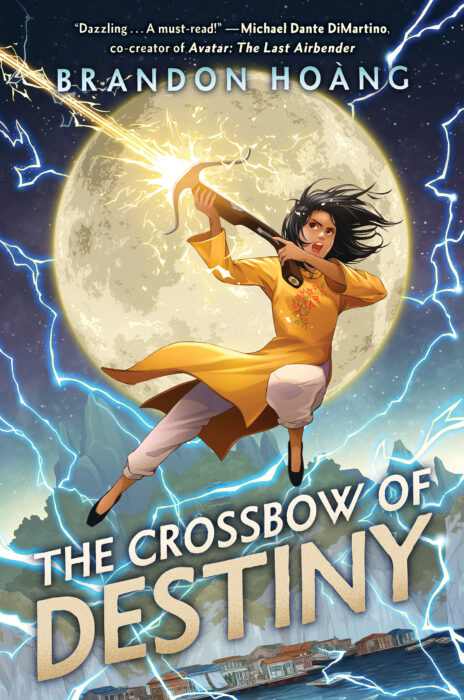
This post continues a two-part post on Brandon Hoang’s novel and aims to provide background information for educators who are teaching this novel at the K-12 level.
SUPPLEMENTARY READINGS: Primary Sources
It appears that Brandon Hoang draws primarily on 14th-15th century versions of the myth of King An Dương. Below are two versions from that time. These translations are a little hard to read because Liam Kelley produced them for researchers, not students. You can also find interspersed translations in Mai Cuong’s article (under “Secondary Sources”).
Vũ Quỳnh, comp. Lĩnh Nam chích quái liệt truyện [Arrayed Tales of Selected Oddities from South of the Passes]. Translated by Liam C. Kelley et al. 1492. Viet Texts. https://sites.google.com/a/hawaii.edu/viet-texts/ [accessed September 1, 2012]. Go to https://sites.google.com/hawaii.edu/viettexts/lncqlt/lncqlt-2, scroll down to “The Tale of the Golden Turtle.”
Ngô Sĩ Liên. Đại Việt sử ký toàn thư [Complete Book of the Historical Records of Đại Việt]. Translated by Liam C. Kelley. 1479, 1697 ed. Viet Texts. https://sites.google.com/a/hawaii.edu/viet-texts/ [accessed 10 Jun 2026]. Go to https://sites.google.com/hawaii.edu/viettexts/%C4%91vsktt-nk/%C4%91vsktt-nk-1, and scroll down to “Annals of Thục/Shu.”
SUPPLEMENTARY READINGS: Secondary Sources
Mai, Cuong T. “Body of Jade, Pearls of Blood: The Evolution of the King An Dương Story and the Moral Imagination of Fifteenth-Century Đại Việt.” Bulletin de l’École française d’Extrême-Orient 108 (2022): 217-288. https://doi.org/10.3406/befeo.2022.6420
Mai’s article is a rigorous comparison of various textual versions of the myth up to the 15th century. Mai’s analysis is dense and confusing at times because there are so many titles, but it is the best and most up-to-date research on myth of King An Dương and its evolution. The article illustrates Freddie’s grandfather’s point that myths evolve over time, and Brandon Hoang is participating in a long history of revising and elaborating on an existing myth.
Kelley, Liam (Lê Minh Khai). “Talking Turtles in Ancient Vietnam.” Le Minh Khai’s SEASian History Blog, 4 Jun 2010, https://leminhkhai.wordpress.com/2010/06/04/talking-turtles-in-ancient-vietnam/
Kelley, Liam (Lê Minh Khai). “Why is Cổ Loa So Unimportant?” Le Minh Khai’s SEASian History Blog, 20 Nov 2015, https://leminhkhai.wordpress.com/2015/11/20/why-is-co-loa-so-unimportant/
Kelley, Liam (Lê Minh Khai). “There Was Never a Kingdom Called ‘Âu Lạc.’” Le Minh Khai’s SEASian History Blog, 10 Jan 2016, https://leminhkhai.wordpress.com/2016/01/10/there-was-never-a-kingdom-called-au-lac/.
These three blogposts by Kelley are shorter and more readable than Cuong T. Mai’s article but much less comprehensive. Kelley includes excerpted translations of early sources for the myth.
HELPFUL NOTES ON “CHINESE” AND “VIETNAMESE” NAMES AND TEXTS
There are both Chinese and Vietnamese records of the myth of King An Dương. Here, “Chinese” and “Vietnamese” are used as a shorthand for texts authored by individuals who were located in or associated with the modern-day countries of China and Vietnam. All of these early records were written in classical Chinese, the language of government, diplomacy, and education in much of East Asia until the modern era. There are two main ways of representing classical Chinese with the Roman alphabet. Some translators use the modern Vietnamese script, called quốc ngữ, while others choose a modern Chinese phonetic transliteration, known as pinyin. Most translators use a combination, but there isn’t a universal standard. Table A below provides the equivalent.
Table A. Names of Historical Figures and Place Names
| Vietnamese quốc ngữ | Chinese pinyin |
| An Dương Vương / King An Dương | Anyang Wang / King Anyang |
| Âu Lạc | Ou Luo |
| Thục Phán | Shu Pan |
| Việt Thường | Yuechang |
| Kim Quy (“Golden Turtle”) | |
| Cao Lỗ / Cao Thông | Gao Lu / Gao Tong |
| Mỵ Châu (also spelled Mị Châu) | |
| Triệu Đà | Zhao Tuo |
| Trọng Thủy | Zhongshi |
| Nam Việt | Nanyue |
Cuong T. Mai’s article examines dozens of Vietnamese and Chinese texts. The earliest sources of the myth were Chinese, and they are listed below in Table B.
Table B. “Chinese” Sources for the Myth of King An Dương
| Century (AD) | Chinese pinyin | Mai translation |
| late 3rd-early 4th century | Rinan zhuan | Accounts of Nhật Nam |
| late 3rd-early 4th century | Jiaozhou waiyu ji | Jiaozhou Outer Region Record |
| 5th century | Shen Huaiyuan, Guangzhou ji | Record of Guangzhou |
| 5th century | Nanyue zhi | Gazetteer of Nanyue |
| 10th century | Taiping huanyu ji | Treatise on the World of the Taiping Era |
Translators do not always translate the name of the same texts the same way, and this can be a possible source of confusion when looking at multiple translations and sources. Table C below provides the different translations of the same Vietnamese texts.
Table C. “Vietnamese” Sources for the Myth of King An Dương
| Century (AD) | Vietnamese quốc ngữ | Kelley trans. | Mai trans. |
| 14th | Lê Tắc, An Nam chí lược | Brief Gazetteer of Annam | |
| 14th | Việt sử lược | Brief History of Viet | |
| 14th | Lý Tế Xuyên, Việt điện u linh tập | Compendium on Mystic Numina of the Viet Realm | |
| 14th-15th | Trần Thế Pháp, Lĩnh Nam chích quái liệt truyện (comp. Vũ Quỳnh) | Arrayed Tales of Selected Oddities from South of the Passes | Gleanings of the Uncanny from South of the Peaks |
| 15th | Ngô Sĩ Liên, Đại Việt sử ký toàn thư | Complete Book of the Historical Records of Đại Việt | Comprehensive Book of Đại Việt Chronicles |
| 16th | Đặng Minh Khiêm, Thoát Hiên vịnh sử thi tập | Thoát Hiên’s Poetic Collection of Odes on History |
READING QUESTIONS
1) According to Cuong T. Mai, how has the legend of King An Dương evolved over time? What plot elements have changed? How have those evolving elements changed the meaning of the story?
2) Brandon Hoang might be considered the latest author to transform the legend of King An Dương. How does his version compare to Chinese and Vietnamese historical records? How has he changed the meaning of the story? Why do you think he made those changes?
3) Brandon Hoang may or may not have been aware of the history of Vietnamese imperialism towards Champa. How would the novel read differently if we take into account that Đà Nẵng and all of central Vietnam once belonged to a different country, Champa? Does that change our understanding of Freddie’s relationship to her birthplace and her family’s home village?
TECHNICAL STUFF
This post and the previous is lightly revised from the material I compiled for the workshop, “Vietnam is Not a War,” organized by the Five College Center for East Asian Studies in Massachusetts.
Hoang, Brandon. The Crossbow of Destiny. New York: Scholastic Press, 2024.
Image credit: https://shop.scholastic.com/parent-ecommerce/books/the-crossbow-of-destiny-9781338789843.html