
I said that my last post was the conclusion to my short series about marriage traditions and my own adaptation of them for my wedding years ago, but I wanted to share some sources and readings for readers who may be planning their own wedding or interested in the history of marriage and fashion in Vietnam. I have not conducted serious academic research on either topic, and I want to emphasize that this list is a starting point based on the works with which I am already familiar. Since my family album covers the Republic of Vietnam (South Vietnam, 1954-1975) quite well, I was mostly looking for images of clothing, fashion, and weddings for earlier periods and for northern Vietnam, and I found that the easily available primary sources actually favor northern Vietnam during the colonial era. This list does not aspire to be comprehensive or exhaustive.
READINGS ON THE HISTORY OF FASHION AND CLOTHING
There isn’t much rigorous English-language research on the history of Vietnamese fashion and clothing, but these two works about the origins of the beauty industry and modern fashion during the French colonial period are a good start. Neither of these readings are free unless you have access to a very good library.
Christina Firpo, Beauty and the Nation: Women, Culture, and the National Image in Interwar Vietnam (New York: Columbia University Press, 2026. https://doi.org/10.7312/firp20886
The 1920s and 1930s in colonial Vietnam was a sea change in women’s clothing and fashion, and some women began wearing makeup, experimenting with new hairstyles, and adopting the latest fashion in clothing. Why explains this change? It’s not that Vietnamese women had suddenly become vainer than ever before. It’s that they were trying to carve out a new role for themselves in Vietnam’s rapidly modernizing society.
Martina Thucnhi Nguyen, “Wearing Modernity: Lemur Nguyễn Cát Tường, Fashion, and the ‘Origins’ of the Vietnamese National Costume,” Journal of Vietnamese Studies 11, no. 1 (2016): 76-128. https://doi.org/10.1525/jvs.2016.11.1.76
Most Vietnamese consider the áo dài to be Vietnam’s national costume, but when did the concept of a national Vietnamese costume even emerge? This article examines the Lemur tunic by the designer Lemur Nguyễn Cát Tường in the 1930s in colonial Vietnam. The Lemur tunic is most often cited as a precursor to the modern áo dài. The article also examines the earliest discussion of a national costume in the Vietnamese-language press.
HOW ABOUT THOSE POSTCARDS?
There is a plethora of free images of Vietnamese historical fashion and clothing on the internet, but the challenge for a researcher is to determine the date of these images. Many articles on the internet provide no information on the year or provenance and state merely that these are “old” (xưa) images. (For newer websites, there is also the question of whether the images are actually historical or generated by artificial intelligence.)
I have found that colonial-era postcards are the easiest images on the internet to date correctly. Old postcards are collectibles, and they are available on many websites, including Ebay and Delcampe, and often reposted elsewhere as well. For example, you can search the internet for “Indochina postcard women” or, in French, “Indochine carte postale femmes.” Searching in Vietnamese is slightly less helpful in that there is a much smaller Vietnamese-speaking collectors’ market. I’m sure there are collectors’ catalogs that provide the exact date of every postcard from colonial Vietnam, but few people own one of those catalogs. Instead, I suggest two relatively easy ways to date old postcards. (Because these images come from online marketplaces, many of the links will go dead once the item is sold.)
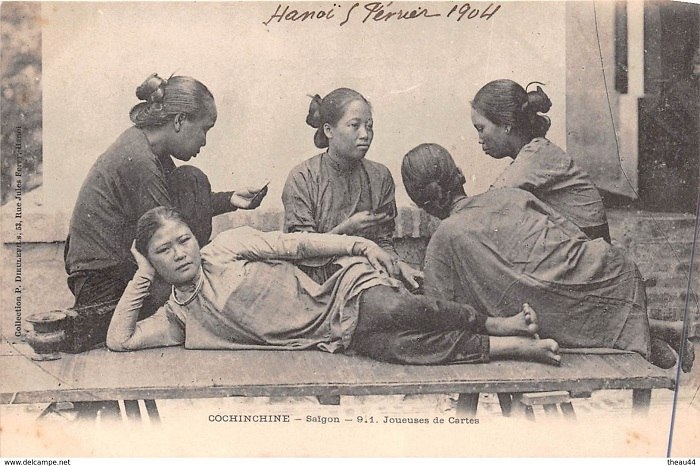
Some websites show both the front and the back of the postcard, and you can find clues for the date on either side. First and most obviously, if the original sender of the postcard included a date, that gives you a sense of when it was sent. For example, this postcard of card players in Saigon is dated by hand on the front at the top: “Hanoï 5 Février 1904.” (I actually am not sure whether that squiggle is a 5 or some other number!)
Second, if there is a stamp, you can date the stamp to get a sense of the date of the postcard. Stamps were issued by governments while postcards were usually produced by private businesses. The precise date of a stamp also affects its value to collectors, especially as some stamps come in series issued over a number of years. Therefore, online marketplaces are far more accurate in providing the date of stamps compared to postcards. The same postcard of the card players can also be found on Delcampe, but this one includes no handwritten date. However, the front shows two stamps, both from French Indochina (Indochine Française): a magenta one worth 4 piasters and showing a woman with some sort of staff, and a gray one showing a Vietnamese woman with a bun with the letters R and F on either side of her. Unfortunately, I cannot make out the value of the second stamp.
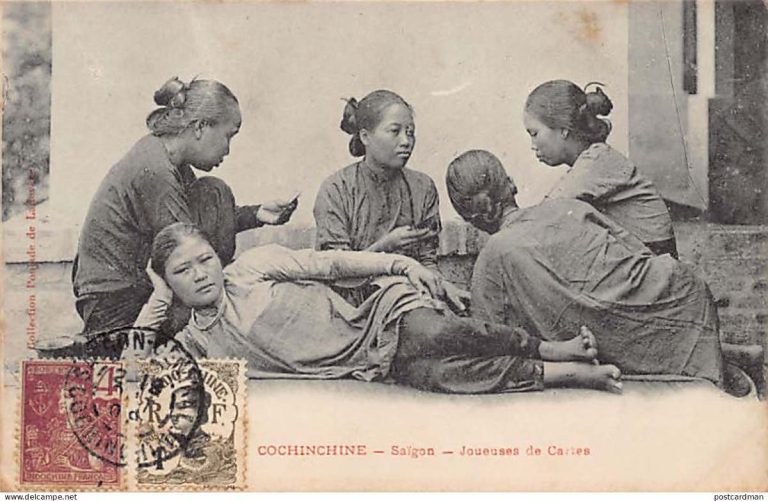
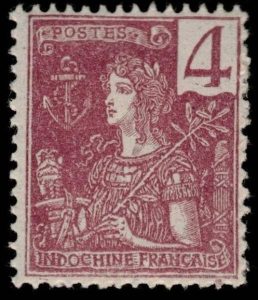
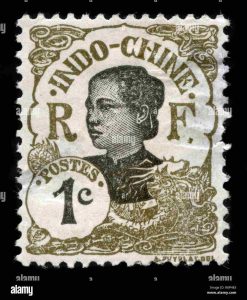
For the pink stamp, a quick internet search for “French Indochina stamp pink 4 piaster” took me to the stamp on the left below, said to be issued in 1904. For the gray stamp, another quick internet search for “French Indochina stamp gray Vietnamese woman” took me to the stamp on the right below, said to be issued in 1907. With these three dates – hand-addressed in 1905, stamps issued in 1904 and 1907 – it’s relatively safe to date the postcard to about 1900 to 1907 and the style of hair and dress shown in the postcard to the first decade of the 20th century.
You can also check stamps against unofficial online catalogs, such as Free Stamp Catalog and Big Blue blog dedicated to stamp collecting. Additionally, as the same postcards can sometimes be found on multiple websites, it’s possible to try this method across different available versions of the postcard to correctly date it. In theory, if a postcard includes a legible postmark, that postmark often includes a date as well, but I have been unable to decipher most French colonial postmarks. Lastly, you can also find general tips for dating postcards from French Indochina (including modern-day Vietnam, Cambodia, and Laos) at the collectors’ website CartaCaro.Com.
GETTING MARRIED IN THE MOVIES, 1950S AND 1970S HANOI
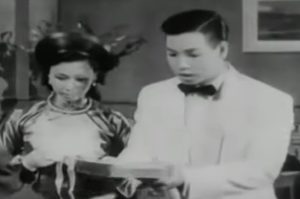
I have been able to track down only two clips of weddings in historical movies that are easily available online. The first image is from the movie Kiếp Hoa (The Fate of a Flower), a film from northern Vietnam in 1953. It was produced in the State of Vietnam, the short-lived, French-sponsored government headed by the last Vietnamese emperor, and set during the Resistance War (Kháng Chiến Chống Pháp, 1945-1954, known in the West as the First Indochina War with the slightly different date range of 1946-1956). Near the end of the movie, there is a wedding between two main characters, a respectable young woman who has been displaced due to war and a wealthy, honorable young man. The wedding takes place in Hanoi at the groom’s home. In this still from about 1 hour, 32-33 minutes into the film (left below), you can see that the bride is wearing an áo dài tunic, a kiềng (Vietnamese-style torque), and a khăn vành dây, or stiff turban inspired by the headwear of imperial women. The groom is wearing a Western suit with a bow tie.
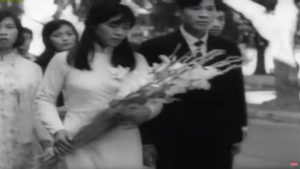
The second image appears only briefly in Em bé Hà Nội (Little Girl of Hanoi), a movie produced in 1974 in the Democratic Republic of Vietnam (North Vietnam) and set during the Christmas bombings of late 1972. About 35-36 minutes into the movie, during a street scene that takes place in Hanoi, the viewer gets a brief glimpse of a wedding procession (above, right). This fictional wedding takes place roughly 20 years after the fictional one in The Fate of a Flower. The bride is wearing a collared áo dài, with some sort of brooch or decoration on the chest, and holding flowers, while the groom is wearing a Western suit and tie.
Fun fact: Kim Xuân, the actress who played the bride’s younger sister in The Fate of a Flower played the friend and co-worker of the main character’s mother in Little Girl of Hanoi.
VIETNAMESE CLOTHING IN HISTORICAL PUBLICATIONS
In my personal library, I found two historical titles with an extensive number of images from the colonial era. Both of these titles are out of print, but they are available at some research libraries.
Pierre Huard and Maurice Durand, Connaissance du Việt-Nam (Hanoi: École Française d’Extrême-Orient, 1954.
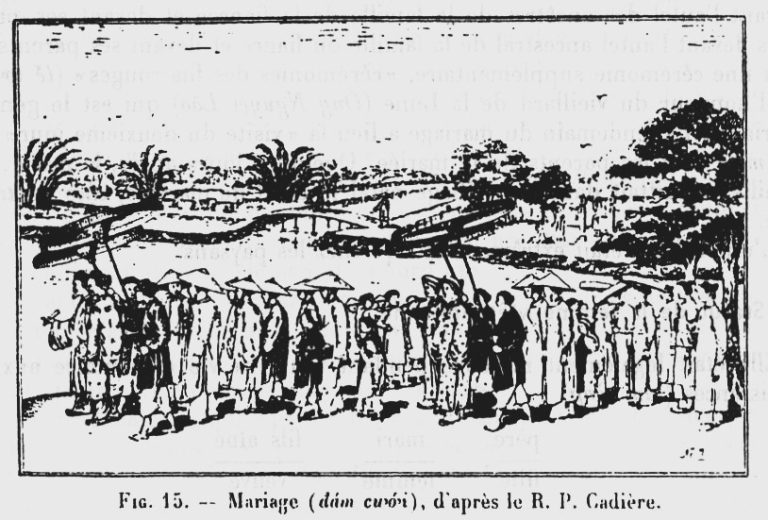
This French-language study examines “traditional” Vietnamese society and culture, mostly in northern Vietnam. It includes chapters on holidays, clothing, food and drink, music, customs, and a wide array of other topics. Even if you don’t know French, the images alone are worth it. Chapter 15 on clothing includes detailed drawings of the layers of clothing for both men and women as well as a comprehensive, catalog-like chart of hats and footwear. You can find an online version of the book at Scribd or purchase it from White Lotus Books. I especially like this drawing of a wedding below.
Quốc văn Giáo khoa thư: Lớp đồng ấu [Langue indigène (Cours enfantin)] ([Hanoi]: Nha Học chính Đông Pháp, 1935; reprint, 1983?).
Quốc văn Giáo khoa thư: Lớp dự bị [Lecture (Cours préparatoires)] ([Hanoi]: Nha Học chính Đông Pháp, 1935; reprint, 1983?). This one does not appear to be available online.
Quốc văn Giáo khoa thư: Lớp sơ đẳng [Lecture (Cours élémentaire)] ([Hanoi]: Nha Học chính Đông Pháp, 1938?; reprint, 1983?).
Luân lý giáo khoa thư: Lớp sơ đẳng [Morale (Cours élémentaire)] ([Hanoi]: Nha Học chính Đông Pháp, 1941; reprint, 1983?).
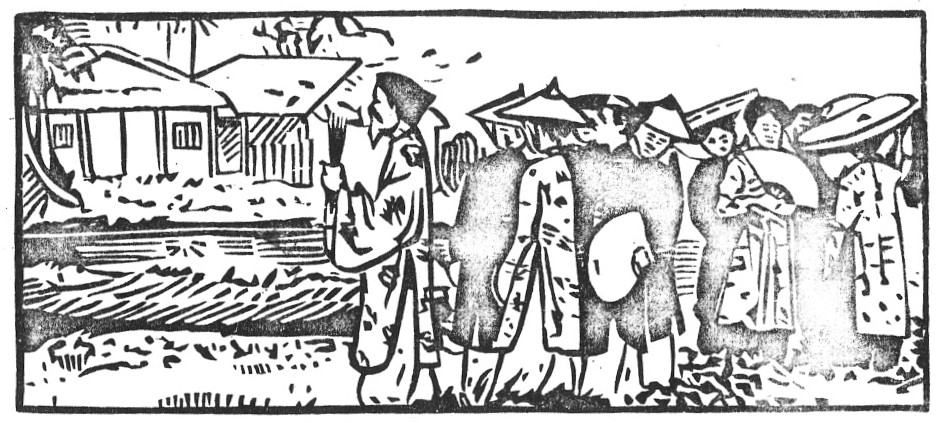
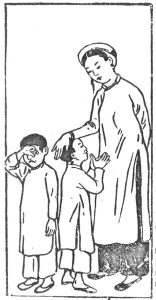
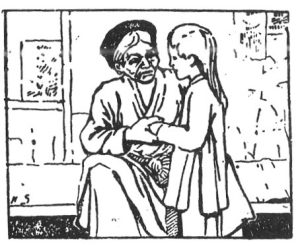
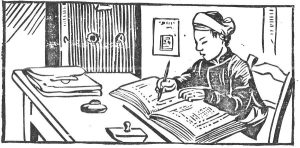
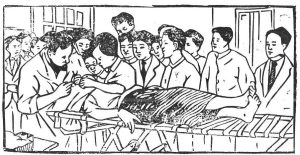
My other favorite title for images of clothing is a series of four primary school textbooks known collectively as Quốc văn Giáo khoa thư (National Language Textbooks)published in the 1930s and early 1940s. (Some library catalogs indicate that publication may have started in the 1920s, but the editions I have are not so old.) I own reprint copies published overseas that my mother bought during our earliest years in America, and she occasionally used them to teach my sibling and me Vietnamese. As a kid, I hated these books with a passion! They were moralistic and didactic, and almost all of the children depicted in them were annoyingly perfect. But as an adult, I find them quaint, and I’m glad my mother introduced them to me. I feel like I share a little bit of the experience of educated Vietnamese who grew up in the late colonial period because I have used the same textbooks as them. For my purposes here, these textbooks includes lots of pictures of Vietnamese of all ages going about their daily activities, so you can find images of the clothing and hairstyles of both men and women, young and old, and rural and urban. These textbooks favor northern Vietnam, and the images tend to be set in an imagined northern Vietnamese village. To be sure, the images are idealized, but they nevertheless provide a window into the visual world of Vietnam in the 1930s. Below a couple of my favorite images. Note the differences in clothing and hairstyles between men and women, young and old, rural and urban.
WHAT ABOUT SOUTHERN VIETNAM?
I am always a little wary of internet sources… especially those videos that purport to depict the history of Vietnamese fashion and all the outfits are wildly and ahistorically colorful! But I found this article on Phụ Nữ Việt Nam from 2017 very interesting. The author has compiled a number of photos of women in Saigon from turn of the century to the early 1970s, and all of the colonial-era images appear to be authentic and correctly identified with southern Vietnam (except the photograph of the young woman in a Lemur áo dài, which may have been taken in Hanoi rather than Saigon). Scrolling through the photos, you can see clearly the abundance of jewelry, hair bun, and five-paneled áo ngũ thân (and never the four-paneled áo tứ thân)that distinguished southern women’s fashion and clothing from their northern counterparts.
ONE LAST READING ON BETEL CHEWING
In an earlier post, I mentioned that there is a strong association between betel chewing and weddings in Vietnamese culture and that there’s even a myth about the origin of the custom. This association also holds in other parts of Southeast Asia and South Asia as well, though I’m far less familiar with those customs. Well, it turns out that the Lao have a far racier myth about the origin of betel chewing, and Liam Kelley ran across a French translation of a Lao manuscript from the 1920s of that story. Somehow, I find the Lao version more entertaining than the Vietnamese one!
IF YOU WANT TO SEE MORE ÁO DÀI…
My colleagues Martina Nguyen, Tuong Vu, and Ann Marie Leshkowich have curated a wonderful exhibition on The Vietnamese Áo Dài in a Time of War: Fashion, Citizenship, and Nationalism (1954–1975). (Also see press coverage by the Boston Globe, behind a paywall.) I was lucky enough to see it at when it opened at the Cantor Art Gallery, College of the Holy Cross, in Worcester, Massachusetts in fall 2024. I don’t know where the exhibit will be traveling next, but hopefully it be coming to a location near you. I can attest that the moment I stepped into the exhibition space and saw all those gorgeous áo dài, I suddenly wanted to go shopping!