
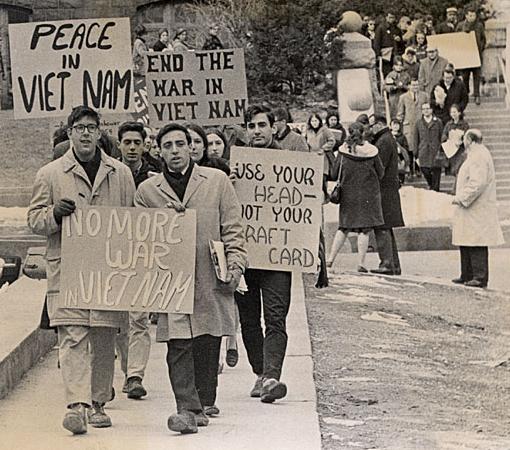
Whatever one’s position is on the Vietnam War, I think just about everyone would agree that the conflict remains a major topic of debate to this day. Of course, wars by their very nature tend to generate controversy, but at least for Americans and Vietnamese, this particular conflict is arguably more contentious than just about any other war of the 20th century. In this last post commemorating the fiftieth anniversary of the fall of Saigon, I want to reflect on the underlying reasons for the unending debate.
There are plenty of interpretative disagreements about the war, some of which date back to the earliest days of the conflict in the 1950s. Was it a civil war, a war of national liberation, or a proxy war? Was it ever winnable for the US and the Republic of Vietnam (RVN, or South Vietnam)? How democratic was the RVN? Was the Democratic Republic of Vietnam (DRV, or North Vietnam) communist or nationalist? Was the National Liberation Front (NLF, colloquially known as the Vietcong) an autonomous revolutionary movement, or was it a front for the DRV? Could the conflict have been resolved peacefully? These questions and variations on them have driven disagreements for decades. In part, the controversies have served as proxy debates about other issues, such as American foreign policy, the US military, the various Vietnamese belligerents, communism, nationalism, and colonialism.
Yet I don’t believe that the war is contentious merely because of interpretive disagreements. Instead, I think the war remains a major topic of debate in large part because it is still so intimately bound up with people’s identities. That is, we tend to assume that an individual’s position on the war says something about what sort of person he or she is. If someone feels feels a certain way about the Vietnam War, then we tend to believe that we can also accurately predict if he or she is right- or left-leaning politically, hawkish or dovish on foreign policy, supportive of the military or not, and conservative or liberal on social issues. Such an assumption makes sense in a way. For the generation of Americans and Vietnamese who lived through the struggle, the war was a defining moment in their political and ethical coming of age. Whether they experienced the conflict as a combatant or civilian and whether they supported or opposed it profoundly shaped their identity. Moreover, at any given historical period, people are not just shaped by a single, dominant event but the larger political configuration in which that event was situated. Thus, the Vietnamese and Americans of that generation came to associate particular views of the war with a set of positions on other political, economic, and social issues.
But what’s odd is that we often apply the same facile assumption even to those who didn’t live through the Vietnam War. That is, it’s often assumed that a person’s opinion of the conflict says something meaningful about his or her identity even if that person has no memory of the event at all. I am a historian of the Vietnam War and a Vietnamese refuge born after the conflict ended, and I cannot count the number of people I have met over my lifetime who wanted to know what side I’m on. For these interlocutors, the answer will presumably provide some insight into who I am. This line of thinking is so commonplace that it’s easy to forget how downright strange it is. If I was of Greek heritage and studied ancient Greek history, no one would ask me, “What side of the Peloponnesian War are you on, Athens or Sparta? And what does that say about you as a human being?” We don’t typically expect anyone to take a strong, partisan positions on historical events that took place before he or she was even alive. Only in the case of the Vietnam War do we hold this bizarre assumption.
The partisan politics of the war and its intertwining with identity is both a burden and boon to historians of the war like myself. On the one hand, partisan passions make talking about the war quite tricky because many people have linked their identity to a singular interpretation of history and instinctively reject alternative viewpoints. I have met former antiwar activists who believed that the conflict was essentially an imperial war between the American empire and Vietnamese national liberation. They became visibly uncomfortable when I talked about the oppression my family endured under the postwar government and immediately changed to the topic to American atrocities against South Vietnamese peasants. I have also known Vietnamese refugees who insisted that the war was a righteous struggle against communism and that anticommunist nationalists like themselves were the only victims. They grew angry when I mentioned North Vietnamese civilians who died during American bombing or the teenage girls that Hanoi sent down the Hồ Chí Minh trail as part of the auxiliary forces. It’s not that my interlocutors were deficient in empathy or failed to grasp that people on all sides suffered. Instead, I think that they have tied their sense of self so tightly to a single, unchanging historical interpretation that other perspectives represented a threat to their identity.
On the other hand, the partisan debate and deep connection to identity means that the Vietnam War remains a topic of perennial interest even half a century later. As long as the war remains both contentious and personal, there will be a steady steam of articles, books, and movies that keep the conflict alive in the popular imagination, and historians of the Vietnam War benefit greatly from the popularity of the topic. Working on a popular topic means that college students eagerly fill our classes, readers outside of the university are interested in our books, and even journalists and filmmakers occasionally want to interview us. Not only does this general interest make my research all the more meaningful, and I don’t think these opportunities would exist if my research was on, say, the Peloponnesian War.
This burden and boon is a contradiction that all historians of the war must live with. So how do we harness this interest in the war while moving beyond the limitations of partisanship and identity? In my course on the Vietnam War, I assign readings that reflect a wide variety of experiences and political views, often views that contradict one another. I want my students to understand that it’s possible have empathy for human beings on all sides, for anticommunist refugees as well as South Vietnamese peasants and North Vietnamese civilians, for hawks as well as doves, and for all soldiers, regardless of the flag under which they fought. None of these experiences are truer or more correct than any other. Instead, they all coexisted within a larger, more complicated history that no singular interpretation can capture.
TECHNICAL STUFF
This post is adapted from comments I made during a roundtable at the Lyndon B. Johnson Library in Austin, Texas, in January 2025.
Image credit: Student protesters at UW Madison. https://firstamendment.mtsu.edu/article/vietnam-war/