
Happy New Year! Chúc mừng năm mới!
A week ago, I made an offering to the Kitchen God on my stove top. The ritual is typically performed on the 23rd day of the twelfth lunar month, a week before new year’s eve according to the traditional lunar calendar. I cleaned the stove, placed three apples and three oranges on a plate, poured some white tea into three teacups, and lit a stick of incense. The offering brought back memories of my own mom making similar offerings when I was a child. I lost my mom several years ago, and performing the ritual that I learned from her made me feel connected to her and the heritage that my parents taught me. In this post, I want to describe the customs surrounding the Kitchen God that I learned my parents.
To start with the basics, the worship of the Kitchen God (Viet. Táo Quân, Ch. Zào Jūn; Viet. Ông Táo, literally “Mr. Táo”) is a custom in Vietnam and East Asia and likely originated in what is now modern-day China. According to tradition, every home has a Kitchen God who oversees all activities in the kitchen. His perch in the kitchen makes the god privy to the family’s words and actions throughout the year, especially as the kitchen is where family members gather for meals and to discuss their affairs. Once a year, on the 23rd day of the twelfth lunar month, that is, a week before year’s end, Kitchen Gods from throughout the earthly realm leave their kitchens and return to heaven. Each Kitchen God then submits a memorial (Viet. sớ; Ch. shū) to the Jade Emperor (Viet. Ngọc Hoàng Thượng Đế, Ch. Yǔ Huang Shàngdì) recounting the moral conduct in his household during the past year. The Jade Emperor is the emperor of heaven in Daoism, and a memorial is a term for official texts submitted to the emperor in dynastic Vietnam and China. The Jade Emperor considers these reports and dispenses rewards and punishments to all households on earth. Naturally, people hope that their Kitchen God will give a favorable report to the powers above, and so they make him an offering – a bribe, really – to encourage him to speak positively about their conduct and remain discreet about their shortcomings.
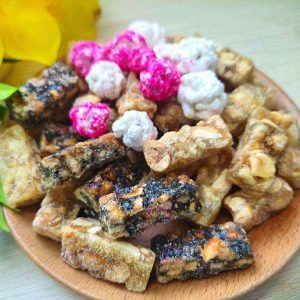
While my mom never failed to make an offering to the Kitchen God, we didn’t actually believe that there was a god in our kitchen or an emperor in heaven. It was all in good fun, and the whole point was to carry on a familiar custom rather than to perform an act of faith. My mom explained to me that she cleaned the stovetop before making an offering out of respect for the Kitchen God. She usually made an offering of tea and thèo lèo cứt chuột, a category of candy that includes bars of sesame and peanut brittle as well as brightly-colored, candy-coated peanuts.As a kid, I thought the name of this candy was just hilarious! Thèo lèo is a seemingly nonsensical alliterative word, and cứt chuột literally means “mouse poop.” My mom said that “mouse poop” referred to the pitch-black color of the sesame brittle made with black sesame seeds. Oddly, my family never offered the comically-named candy in any other ritual and seemed to reserve it for the Kitchen God, which meant it took forever to work through a package of that candy. It wasn’t until years later that I realized that thèo lèo cứt chuột is considered a cheap offering, something to be offered to the Kitchen God, other minor deities, and wandering ghosts, but usually not your own ancestors or the Buddha.
Some years, my mom also made chè trôi nước, or “flowing water dessert pudding.” Chè trôi nước isa delicious dessert of sticky-rice dumplings floating in a ginger syrup and topped with coconut cream and white sesame seeds. The small dumplings have no filling, but the big ones are filled with mung bean paste. When you bite into a big dumpling, it’s a perfect contrast of flavor and texture, as the sweet syrup moistens the plump, chewy dumpling and soaks the dry, nutty bean paste. My sibling and I happily devoured this decadent dessert the minute the incense burned out, which meant that the Kitchen God had finished eating. I can’t speak for the Kitchen God, but a bowl of chè trôi nước would have certainly convinced me to give a favorable report to the Jade Emperor!
My parents also explained that it was traditional to burn joss paper as part of the offering, though we never did. Joss paper (đồ mã) is a paper item made specifically to be burnt as a form of worship. My parents recounted that the most common joss paper for the Kitchen God was shaped like a mandarin’s robe, a carp, or a horse. The Kitchen God was an official, or mandarin, who served the Jade Emperor and was said to ride a carp or horse to get to heaven. Thus, these items were gifts meant to help him on his journey. My dad never failed to point out that it was customary to offer joss paper robes but not joss paper pants, and he humorously concluded that the Kitchen God didn’t wear pants. Whenever my dad wanted to buy new pants or found that all of his pants were in the wash, he would march through the house and declare loudly to all who would listen that he was the Kitchen God and had run out of pants to wear.
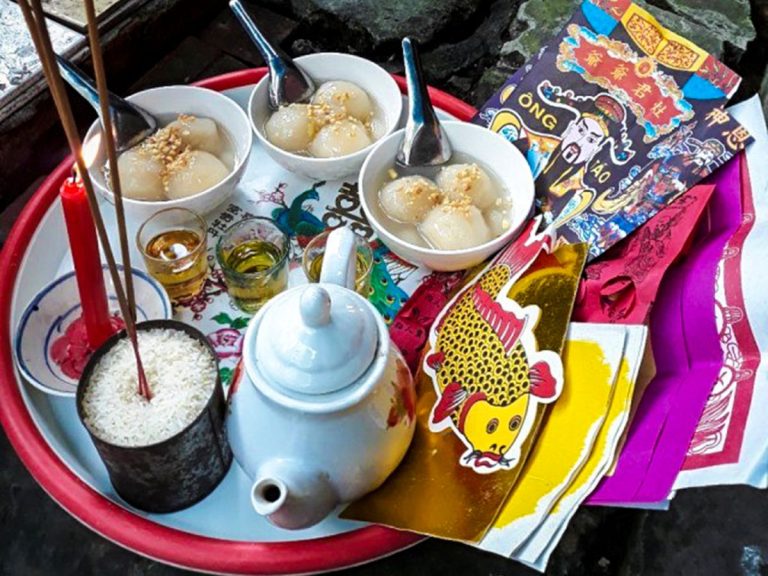
One year, I asked my mom why the offering she made to the Kitchen God came in sets of three: three teacups and three bowls of chè trôi nước, though usually only one dish of thèo lèo cứt chuột. That was when she explained that there’s actually a trinity of two gods and a goddess that are collectively known as the Kitchen God. Her version of the story went something like this: There was once a married couple who was poor and had to separate, and the wife eventually remarried. One day, when the wife was home alone, a beggar knocked on her door, and she recognized the ragged figure to be her former husband. She was overcome with pity and invited him in. But her second husband returned home, and fearful of his response, the beggar hid in the pile of hay by the stove (or possibly in the hearth). The second husband lit the hay on fire to warm up the house, and the beggar burned to death. The wife felt so deeply for her unfortunate former husband that she jumped into the fire and died as well. Her second husband was shocked and saddened (and deeply confused, I assume!), and he immediately jumped into the fire to join his wife in her fiery death. The emperor of heaven was moved by the integrity and sincerity of all three and made them the god of the kitchen.
As the date for sending off the Kitchen God approached this year, I found myself wondering how my family’s practices compared to the custom of other Vietnamese. A quick search led me to a fascinating article entitled, “The Kitchen God Returns to Heaven [Ông Táo Về Trời]: Social Knowledge and Folk Beliefs in Vietnam,” by Patrick McAllister and Thi Cam Tu Luckman. The co-authors explain that there are significant regional differences in the offerings. Northern Vietnamese prepare elaborate, savory meals including the conventional dishes associated with Lunar New Year in their region, such as boiled chicken and fried egg rolls (nem rán). In contrast, southerners like my mom favor sweeter fare, especially the familiar thèo lèo cứt chuột and chè trôi nước of my childhood. Although McAllister and Luckman don’t state this explicitly, these two foods appear to be specifically, though not exclusively, associated with sending off the Kitchen God in southern Vietnam.1 There’s also a large body of mythology surrounding the deity of the hearth in East Asia, but McAllister and Luckman point out that the story about the love triangle leading to a fiery death and resulting in a trinity of two gods and one goddess appears to be unique to Vietnam. There is apparently no evidence of that tale in Chinese culture. However, the particular version my mom told me is only one of many variations on the story.2 Just as there are regional variations of the custom within Vietnam and ethno-national variations across Asia, I have decided that my offerings will be yet another variation, something that rhymes with my mom’s practice rather than repeats it. I now find chè trôi nước and thèo lèo cứt chuột too sweet, so the god of my kitchen must settle for less sugary snacks. Following my family’s custom (and southern Vietnamese tradition), my offering consists of simple fare rather than a full meal, leaning sweet more than savory. It’s usually just tea, fruit, and perhaps crackers, with everything in sets of three to honor the specifically Vietnamese trinity of two gods and a goddess. Most importantly, sending off the Kitchen God is a ritual to mark the passage of time, reflect on the past year, and remember the customs that link me to the generations that came before as well as the variations that each generation has introduced.
NOTES
1 Patrick McAllister and Thi Cam Tu Luckman, “The Kitchen God Returns to Heaven [Ông Táo Về Trời]: Popular Culture, Social Knowledge and Folk Beliefs in Vietnam,” Journal of Vietnamese Studies 10, mo. 1 (winter 2015): 110-150, reference to 117-118.
2 McAllister and Luckman, “The Kitchen God Returns to Heaven,” 111-117.
NOTE FOR RESEARCHERS
McAllister and Luckman’s article can be found here: https://doi.org/10.1525/vs.2015.10.1.110.
IMAGE CREDIT
The photo of chè trôi nước can be found here: https://moshimoshi.vn/bay-cach-dua-ong-tao-ve-troi-cuc-chuan-de-nam-moi-nhieu-tai-loc.
The photo of thèo lèo cứt chuột candy can be found here: https://bachhoa.extra.vn/keo-theo-leo-bong-dau-500g-keo-dau-phong-theo-leo-truyen-thong-l1716585584.html.