
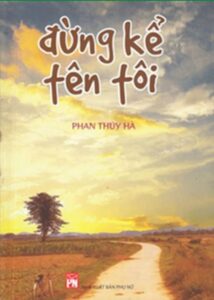
I am marking the 50th anniversary of the Vietnam War in 1975 with an irregular series that reflects on the war’s end and its aftermath. This third second post is about Phan Thúy Hà’s Don’t Mention My Name, which serves as a foil to Phan Nhật Nam’s Stories Along the Road.
Phan Thúy Ha’s Don’t Mention My Name (Đừng kể tên tôi, 2017) gives voice to North Vietnamese peasants, a group of Vietnamese that we rarely hear from in English-language writing about the Vietnam War. The author was born in Hà Tĩnh province in north-central Vietnam in 1979. Her father fought for the Democratic Republic of Vietnam (DRV, or North Vietnam), and Phan Thúy Hà became interested in preserving stories from the war generation. She conducted extensive interviews with her neighbors and friends, and Don’t Mention My Name, her debut work, is a collection of personal narratives drawn from these interviews.
Phan Thúy Hà aimed to capture the experiences of ordinary people during and after the war, and the book emphasizes the ordinariness of her interviewees. The foreword, written by Thái Kế Toại, a close friend and brother-in-arms of the author’s father, stresses that she wanted to record the actual experiences of the people in her community, not to glorify them or to seek out exceptional individuals (6-7). The author also highlights the modesty of her informants. Many of them felt that their experiences were rather insignificant and wanted their testimony to remain anonymous. “Don’t mention my name,” many of them told Phan Thúy Hà (hence the title of the book), but they all eventually allowed her to record their names and residences (12).
Indeed, it is the very ordinariness of these stories that make them meaningful. Although neither Phan Thúy Hà nor Thái Kế Toại say so explicitly, the author’s refusal to turn her interviewees into larger-than-life heroes is an indirect critique of communist propaganda. During the war, the DRV portrayed its soldiers and civilians as unwaveringly brave and self-sacrificing in their noble struggle to save the nation, and North Vietnamese writers had little choice but to conform to this interpretation in their works of literature. After the war, official portrayals of the DRV’s defeat of the RVN presented it as a joyous liberation welcomed by all Vietnamese. Only in the late 1980s and early 1990s, when the government introduced market reforms known as “economic renovation” (đổi mới), did dissident intellectuals directly challenge the artistic dogma. They wrote about the war as a tragic, futile effort that had left the population scarred and impoverished. Don’t Mention My Name is less direct than the dissident literature of economic renovation. Instead, it quietly suggests that exaggerated, propagandistic depictions of ordinary people have robbed them of their humanity.
Although the narratives in the collection are not the actual transcripts of the interviews, the voices of the Hà Tĩnh peasants nevertheless shine through. The stories are written in a raw, unembellished, and often colloquial style. Minimally stylized and edited, they evoke the salt-of-the-earth dignity of Phan Thúy Hà’s informants. Some are presented entirely in the first person from the perspective of the interviewee, but in other cases, the author describes her visits to her interviewees’ homes and the questions she posed. Yet Phan Thúy Hà’s touch is so deliberately light that I would almost characterize her as a ghostwriter.
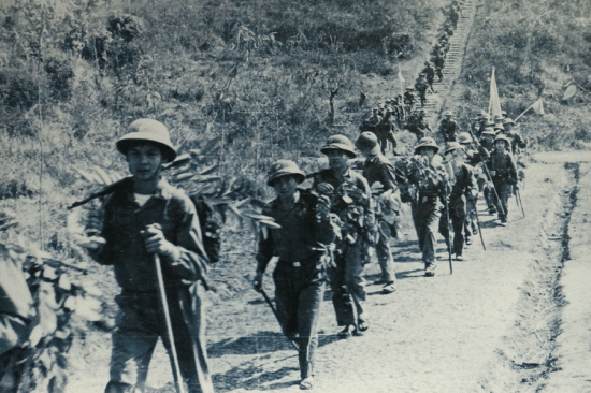
Perhaps my favorite piece in the collection is “The Man by Ngàn Sâu River” (“Người bên sông Ngàn Sâu,” 16-115), a coming-of-age story of a young soldier named Ngọc. The piece is the longest in the collection at a hundred pages and takes its name from the river that runs through Hà Tĩnh province. The first third of the novella-length narrative covers Ngọc’s experience as a peasant boy from 1965 to his enlistment in 1970. The middle part of the narrative follows him into the army, down the Hồ Chí Minh Trail, and through some forty-odd battles. The last third recounts his experience in the final offensive against the RVN in the spring of 1975 and his experiences in postwar Saigon. I was especially drawn to the first and last part because they depict his first introduction to war and his social (rather than military) encounters with Vietnamese on the other side.
“The Man by Ngàn Sâu River” opens with a surprisingly funny story about the American bombardment of Ngọc’s village. Ngọc was herding water buffalo out in the fields when the first US bombs rained down in his village in 1965, at the start of Operation Rolling Thunder (1965-1968). Soon, he learned that DRV defenses had shot down the American plane and that the pilot had been captured by regular troops and the local militia. The authorities then put the pilot on display for the local population, and curious little Ngọc jostled with other peasants to get a good view of the tall, pallid, blue-eyed foreigner who had been responsible for so much death and destruction. The pilot, who knew no Vietnamese, indicated to his captors through hand signals that he needed to use the bathroom, and the spectators waited patiently while he took care of his bodily needs. But what no one anticipated was that the American was too large for a Vietnamese outhouse! And thus began an unexpected comedy. The American tried to squeeze into the outhouse but got stuck in the tiny doorframe, and a local militia woman had to help push him in. Then, the American squatted on the planks over the pit latrine, but the planks broke under his weight, and he fell straight into the pit. Ngọc and other peasants stared as local militia women rescued the soiled American and doused him with water to wash off the excrement. Both shocked and fascinated by the strange scene, Ngọc watched with his mouth agape and found himself thinking, “So this is the American enemy that flies planes and drops bombs on my village” (“Tên giặc Mỹ lái máy bay thả bom xuống làng quê tôi là như thế này sao,” 18, emphasis added). However fearsome American bombers were, the humiliation of the downed pilot and his physical needs must have humanized him in Ngọc’s eyes. (Phan Thúy Hà adds in a footnote that the pilot was William Andrew Robinson, captured in September 1965. However, Robinson’s biography does not mention the latrine incident, and I have not been able to independently confirm the identity of the pilot.)
More seriously, the American bombing campaign cast a long shadow over Ngọc’s childhood and shaped his eventual decision to volunteer for the army. He and his family and neighbors lived in constant fear of the next attack, and he even watched a close friend burn to death. But it was only after he began attending political study classes offered by the local collective that he could make sense of the tragedy. These classes taught him that the bombing was part of a larger American effort to annex and occupy Vietnam. The US had already captured the southern half of the country and was now attacking the north, he learned. The message was further reinforced by propagandistic movies, and Ngọc dreamed of sacrificing his life to fight for his country just like the youthful heroes in those movies. He eventually left secondary school to join the army in about 1970 or 1971, promising himself to live up to the example of the self-sacrificing heroes. Over the next five years, he proved himself to be a good soldier and rose to become a platoon commander.
For most of the story, Ngọc referred to the military of the RVN as “the enemy” (địch), and people on the other side appear as little more than a shadowy, violent force that he must fight. But towards the end of the war and the end of the narrative, he was forced to fully confront these other Vietnamese as human beings with their own political views. In the spring of 1975, the RVN’s military abandoned the Central Highlands, withdrew to the coastal lowlands, and retreated southward towards the capital. Meanwhile, the DRV’s military advanced steadily, capturing province after province, and Ngọc was among the North Vietnamese foot soldiers that participated in what would become the final offensive of the war.
Ngọc was a committed soldier who sincerely believed that he was liberating his country from American imperialism, and he was surprised to find that Vietnamese on the other side regarded him as the enemy. As his unit captured the highlands, he was distressed to see millions of South Vietnamese civilians fleeing rather than welcoming his arrival. Many died from exhaustion, starvation, or injuries in their attempt to escape. (77) Ngọc told himself that the population had simply been conditioned to think of communists as “savage beasts who would tear open bellies and steal livers” (“Việt cộng là con thú ác. Việt cộng sẽ mổ bụng moi gan”: Phan Thúy Hà 77, trans. Alex-Thái Đình Võ). In the coastal town of Tuy Hòa, a group of local teenage girls stared hard at him and his comrades because, as one girl explained, they had heard that North Vietnamese soldiers had tails and fur just like monkeys. Ngọc instinctively attributed such ridiculous rumors to anticommunist propaganda (80).
The young soldier longed to be accepted by the local population in South Vietnam and rejoiced in brief moments of shared humanity with them, but these moments proved too fleeting to overcome differences. As his unit advanced from the Central Highlands down to coast, he was touched to see his comrade Huỳnh, a medic, save the life of a South Vietnamese soldier’s wife who had miscarried while fleeing the communist advance. (78) Ngọc marveled, “Just yesterday, the husband and Huỳnh had aimed their guns at each other, but now they sat side by side in this situation” (“Hai người hôm qua còn chĩa súng vào mặt giờ ngồi với nhau trong tình cảnh này”: Phan Thúy Hà 79, trans. Alex-Thái Đình Võ). He later benefitted from similar kindness by a doctor on the other side after being badly injured during the attack on Saigon (90). Yet when he later visited the doctor to express his gratitude, she seemed awkward and distant. He eventually heard that she was a widow of an RVN captain and had escaped the country soon after his visit (95). It was a shocking and poignant realization for Ngọc. The doctor may have been willing to save his life, but she would rather flee her homeland than live under the government for which had fought.
The more Ngọc interacted with Vietnamese who had supported the RVN, the more contradictory his relations with them became. He received care during his convalescence at a military hospital that had been operated by the RVN. A compassionate RVN military doctor took special care of him and even invited Ngọc to visit the doctor’s home, and Ngọc soon became friends with the doctor and his wife. It was at the doctor’s home that the young peasant soldier from northern Vietnam tasted ice cream for the first time in his life. But as delicious as the treat was, Ngọc suddenly feared that his new friend was poisoning him and abruptly stopped eating the ice cream (96-98). The doctor later received a summons from the postwar authorities to register for reeducation and asked Ngọc for his opinion, and the loyal communist soldier urged the doctor to comply. There was nothing to fear, Ngọc confidently assured his kind friend. (100) But months later, Ngọc received anxious letters from the doctor’s wife about her husband’s seemingly indefinite detention. Suddenly, Ngọc realized that he was merely a foot soldier who had no power to help his former benefactor and, uncertain what to write, he decided not to respond to the wife’s letter at all. (101-102) Although Ngọc does not state so explicitly, he must have realized that he could no longer blithely dismiss the misgivings of Vietnamese on the other side.
Thinking back to my last two posts in this irregular series, I would describe Phan Thúy Hà’s Don’t Mention My Name as a sort of foil to Phan Nhật Nam’s Stories Along the Road. Phan Nhật Nam is a combatant who fought in the war, while Phan Thúy Hà is a civilian born after the war. The former is stridently anticommunist and aligned with the Republic of Vietnam (RVN, or South Vietnam), but the latter does not explicitly espouse a political position though her father served the DRV. The vignettes in Stories Along the Road were mostly (but not exclusively) of Vietnamese on the losing side, especially war widows, refugees, and prisoners that suffered under the postwar communist government. In contrast, Phan Thúy Hà emphasized the suffering of northern peasants due to war rather than any particular regime. While Phan Nhật Nam inserted himself quite a bit into his anthology and even chose to fictionalize some stories, Phan Thúy Hà acted almost as a ghostwriter for her interviewees. He was interested in emotional truth more than historical fact, while she favored authenticity over stylization. Together, they offer two very different approaches to preserving and shaping historical memory.
THE TECHNICAL STUFF
Note for readers: A portion of “The Man by Ngàn Sâu River”has been translated into English. See Phan Thúy Hà, “The Man by Ngàn Sâu River,” trans. Alex-Thái Đình Võ, Journal of Vietnamese Studies 20, no. 2 (2025): 26-31, https://online.ucpress.edu/jvs/article/20/2/36/209891/The-Man-by-Ngan-Sau-River-Ngu-i-ben-song-Ngan-Sau. I was a guest co-editor of the special issue of JVS in which this translation appeared, and some quotes in this blog post are taken from Alex-Thái Đình Võ’s translation, as noted. The publisher has made the translation free for now.
Note for researchers: “The Man by Ngàn Sâu River” would be great for scholars interested in Operation Rolling Thunder, social life in Hà Tĩnh province during the Vietnam War, soldiers’ experiences in the People’s Army of Vietnam, the Battle of Kontum (1972), the DRV’s spring offensive of 1975 and the fall of the RVN, and the immediate months after the war.
The version I read: Phan Thúy Hà. Đừng kể tên tôi. Reprint ed. Hanoi: Phụ Nữ, 2018.
Image credit: Photo of PAVN soldiers on the Hồ Chí Minh Trail can be found here: https://baodaklak.vn/channel/3721/201905/chu-tich-ho-chi-minh-voi-tuyen-duong-truong-son-5634791/. The book cover can be found here: https://www.goodreads.com/book/show/53987616-ng-k-t-n-t-i.