
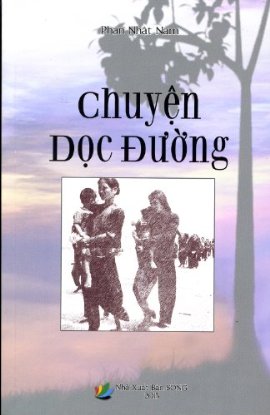
I am marking the 50th anniversary of the Vietnam War in 1975 with an irregular series that reflects on the war’s end and its aftermath. This is my second post, and it builds on my first one about Phan Nhật Nam’s Stories Along the Road, a book that reflects the long arc of recent Vietnamese history from war to troubled peace.
As I mentioned in my last post, Phan Nhật Nam’s Stories Along the Road (Chuyện dọc đường, 2013) is a collection of vignettes about ordinary Vietnamese during and after the war. Although he claims in the preface that he collected these stories on the Little Saigon bus that ran between San Diego and Los Angeles, no more than half of the chapters explicitly reference the bus. The others recount experiences from the author’s own life and those of the people he met in and out of prison after the war. While my last post focused on two vignettes about women, this one will examine three vignettes about reeducation camp.
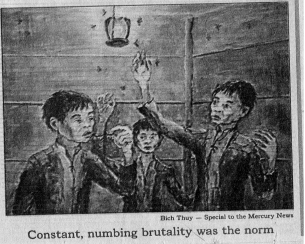
After the end of the Vietnam War, the postwar Socialist Republic of Vietnam (SRV) imprisoned hundreds of thousands of Vietnamese that had been affiliated with the defeated Republic of Vietnam (RVN, or South Vietnam). The communist authorities targeted former government officials, military officers, and even intellectuals whose works they deemed reactionary. First, many political prisoners underwent “self-criticism” during which they had to confess to crimes that they had supposedly committed against the revolution. Then, the government carted off the detainees to prison. While some were informed of the charges against them and given actual sentences, many were never told why or how long they were being held. These prisons were known euphemistically as reeducation camps because they aimed to reeducate reactionaries and transform them into good socialist citizens. But in practice, the detainees had to perform hard labor, endured hours of political indoctrination, and often suffered from overcrowding and inadequate nutrition and healthcare. For many reeducation camp inmates, the worse part of their imprisonment was the indefinite separation from their families. The authorities rarely allowed family members to visit and frequently moved the prisoners without informing their loved ones. The period of detention ranged widely, from a few months to over a decade, and prisoners came home to impoverished families, intense government surveillance, and political discrimination. The reeducation camp system lasted until the mid-1990s. But the regime never released official figures on the number of prisoners. Even now, researchers are uncertain as to how many were detained, and estimates range from hundreds of thousands to over a million.
Stories Along the Road includes numerous vignettes about reeducation camp. Some are about Phan Nhật Nam’s own experience and written in the third person in a dreamlike, stream-of-consciousness style. Others are about inmates that the author met or heard about, and he sometimes inserts himself as an anonymous prisoner who witnesses events. The vignettes are not related except that they mostly take place in one of two prison camps: the cold and remote Camp Hoàng Liên Sơn, located in the tallest mountain range in Vietnam in the northwestern part of the country, and Camp 5 Lam Sơn, located in the north-central region in the home district of historical figure, Lê Lợi. In the fifteenth century, Lê Lợi famously led the resistance against the (Chinese) Ming Occupation (1407-1427) and later founded the Lê dynasty (1428-1527). These are not connected vignettes, and the characters in one story generally do not appear in the other stories, with the exception of the author.
If there is a unifying theme among the prison vignettes, it is the contradiction between the humanity and savagery of imprisonment, and this binary aligns with the author’s highly partisan, anticommunist politics. Phan Nhật Nam describes postwar Vietnamese prisons as housing both political detainees sent to reeducation camp for their past affiliation with the RVN as well as common criminals who had committed non-political crimes under the wartime Democratic Republic of Vietnam (DRV, or North Vietnam) or postwar Socialist Republic of Vietnam. But the author is clearly only sympathetic with the former group. He depicts political prisoners as honorable people who are unjustly imprisoned and forced into physical degradation. These prisoners manage to preserve their humanity in spite of their physical suffering and their encounter with cruel guards and criminals. In contrast, Phan Nhật Nam portrays tcommon criminals as savages or savage-like, and their physical imprisonment confirms their moral degradation.
“The Waterpipe” (“Chiếc ống điếu thuốc lào,” 13-26) is the opening vignette of the entire collection and recounts the story of Lieutenant Colonel Lê Lô, a former commander of the Seventh Paratrooper Battalion of the RVN and a prisoner in Camp Hoàng Liên Sơn. The vignette begins with the conversation between two passengers on the bus. The first passenger shows off an exquisitely carved waterpipe used for smoking strong tobacco (thuốc lào), a favored variety of tobacco in northern Vietnam. He boasts that the pipe once saved several people’s lives and explains that he intends to return the pipe to his friend, Lieutenant Colonel Lê Lô, nicknamed “Lô River.” (The Lô River in northern Vietnam was the site of a celebrated Vietnamese victory over the French in 1947 during the war of independence.) Then, the vignette switches to the third person and recounts Lô’s exploits in prison in about 1977. Unlike other prisoners, the lieutenant colonel ignored all orders to attend “political study” classes, and the camp authorities punished him by chaining him naked in an underground isolation cell for two months. Upon release, he forcefully declared before the entire camp that he shouldn’t have to study or “self-criticize” – that is, attend political indoctrination classes. His actions made clear that he believed he was right to have fought for the RVN, that the communist government was illegitimate despite its military victory, and that no physical torture no matter how savage could break his spirit. Lô’s courageous defiance won him the admiration of fellow inmates, and a prisoner who was formerly the commander of a Special Forces unit gave Lô the gift of a beautiful waterpipe. Lô politely declined and said that he could not accept it at that time. Later, he organized an escape with four other prisoners, but they were caught and dragged back to camp. Facing imminent execution, Lô calmly asked to smoke strong tobacco one last time using the beautiful waterpipe. The guards granted his dying wish. Just as he finished smoking, orders arrived to stay the execution, and the waterpipe thus saved the lives of Lô and the other escapees. In the eyes of the first passenger, the waterpipe is a reminder of Lê Lô’s courageous and principled resistance against an oppressive power. After hearing the story, the second passenger wonders if the guards were merely trying to intimidate the prisoners and never actually had plans for execution at all.
“The Story of Công the Biter” (“Chuyện ‘Công cắn,’” 75-84) emphasizes the degradation of imprisonment far more than “The Waterpipe.” The title character, Công, was a prisoner in Camp 5 Lam Sơn who stooped to anything to ensure his survival and that of his younger brother, also an inmate. The reader never learns why Công was in prison and whether he was a political prisoner or a common criminal. Whatever the case, the vignette depicts Công as lowly and animal-like, almost feral. He stole food from other prisoners, ate food that had touched fecal matter, and ferociously bit other inmates when he got into fights, thus earning his nickname “Công the Biter.” He even allowed himself to become soiled with feces and urine and weaponized his unbearably disgusting body to win fights. But as disgusting as he is, he fiercely loved his younger brother and protected the latter from harm. Eventually, Công hatched an escape plan for the two of them that required them to crawl through the latrines, but the brother was shot during the escape while Công was captured alive. Công later learned that Nhiền, a North Vietnamese common criminal, had ratted out the brothers to the guards, and Công was bent on revenge. The prison authorities had rewarded Nhiền by transferring him to nearby Camp Thanh Cầm and giving him a position of minor authority over other inmates. Soon thereafter, Công bit off the finger of a prison guard so he could be punished and transferred to Camp Thanh Cầm too.
The perspective then abruptly switches to an unnamed prisoner in an isolation cell, who is obviously Phan Nhật Nam. The anonymous prisoner overheard Công’s final life-and-death struggle against Nhiền. Once again weaponizing the disgust of others, Công emptied a tube of feces into Nhiền’s face, knocked over the shocked Nhiền, and gouged out the latter’s eyes and ferociously ate them. The guards immediately shot Công dead. The prisoner in the isolation cell nearly vomited in disgust at the horrific incident. The scene juxtaposes Nhiền’s physical disgust at human feces and the nameless prisoner’s moral disgust at Công’s savagery. Ultimately, the vignette highlights the seeming contradiction between Công’s deep, almost defiant love for his younger brother and the physical and moral depths to which he descended to avenge his brother. It is a contradiction made even starker by the extreme conditions of prison life.
“The Women at Camp 5 Lam Sơn” (“Những người đàn bà nơi Trại 5 Lam Sơn,” 131-145) is unusual among the vignettes in that it features women prisoners and explicitly examines the interaction between political prisoners and common criminals. In the vignette, three political prisoners pushed a cart of grain from one part of the camp to another. They included two former military officers and a former professor affiliated with the RVN. Along the way, they passed by three North Vietnamese women prisoners. The professor politely greeted the young women and was taken aback by their foul-mouthed response. The women admitted to being sex workers. They mocked the political prisoners for being even inferior to ex workers, for sex workers only sold their bodies while the men sold out their country, presumably by serving the RVN.
The political prisoners eventually reached the storage pit for the grain, where they encountered a friendlier North Vietnamese woman who had been imprisoned for two decades. She explained that she was a member of an ethnic minority from the local province and had been been accepted into the communist party before being arrested. The party had arranged for her to marry a sickly Vietnamese man and gave her a job raising ducks on a collective farm. One day, her husband berated her for being lazy, and she stabbed him to death in her blind fury. She then calmly returned to her work preparing duck feed. When her father-in-law discovered the murder, she angrily stabbed him too. Once again, she continued preparing duck feed as if nothing had happened and even used some of her dead husband’s flesh. The three prisoners were sickened by the cold-blooded murder and the grotesque savagery of feeding human flesh to poultry. The vignette juxtaposes the two groups of prisoners. The first were polite, educated, innocent men from the RVN who were forced to perform degrading labor in prison. The second were rude, licentious women who lived under the DRV and who degraded themselves themselves physically and morally. The implication is that their imprisonment is deserved.
When read together, these vignettes portray the prisons of postwar Vietnam as an institution that conformed to no moral order, that threw together the innocent with the guilty and the noble with the savage. Given the political orientation of the collection as a whole, I think that the stridently anticommunist Phan Nhật Nam meant for these prisons to be a stand-in for the postwar government. That is, the author appears to be suggesting – without too much subtlety – that the postwar government was so utterly amoral in its inability to distinguish right from wrong that it had turned all of postwar Vietnam into an open-air prison. This view was common in Vietnamese literature written by anticommunist refugees in the two decades following the fall of Saigon, and Stories Along the Road squarely belongs to that body of literature.
THE TECHNICAL STUFF
Note for readers:Stories Along the Road has not been translated into English, and the original Vietnamese is not available online. A handful of libraries in the US have a copy of the Vietnamese original, and it is also for sale here: https://www.nguoivietshop.com/products/123-chuy%E1%BB%87n-d%E1%BB%8Dc-%C4%91%C6%B0%E1%BB%9Dng/.
Note for researchers: This book belongs to Phan Nhật Nam’s extensive postwar oeuvre. The vignettes describe here would be great for scholars interested in Phan Nhật Nam’s life and work, RVN soldiers, postwar Vietnam, reeducation camps, anticommunism, prison memoirs, and the literature of the RVN diaspora.
The version I read: Phan Nhật Nam. Chuyện dọc đường. Westminster, CA: Sống, 2013.
Image credit: The cover of the book can be found here: https://www.nguoivietshop.com/products/123-chuy%E1%BB%87n-d%E1%BB%8Dc-%C4%91%C6%B0%E1%BB%9Dng/. The drawing of the reeducation camp inmates if by Bich Thuy, published by the Mercury News, clipping photographed by Anna Mallett: https://www.thevietnamese.org/2024/05/post-1975-tragedy-the-grim-reality-of-life-in-vietnams-re-education-camps/.