
I originally meant to post this on Christmas Day 2025, but my blog ran into some technical problems that took some time to resolve.
What was Christmas like in the Republic of Vietnam (RVN, or South Vietnam)? Two years ago, I briefly mentioned my mother’s memories of Christmas celebrations in Saigon in the early 1970s. Unlike her, I was born after the fall of the RVN, and I can only experience these historical Christmases vicariously through her stories and through primary sources that I have found in my research. In this post, I share a few images from historical periodicals from the RVN during Ngô Đình Diệm’s rule (1954-1963).
Although Christianity is a minority religion in Vietnam, Christmas was and is quite popular among middle-class urbanites who are not Christian, and the coverage of Christmas in the RVN’s media reflected this. Even non-religious magazines and newspapers produced special issues for Christmas. The first image I am sharing is the cover of the glossy magazine, The Bright Shining South (Sáng dội Miền Nam), for Christmas 1960. The Bright Shining South was a coffee table magazine full of colorful photos and fluff stories on arts and entertainment. Perhaps unsurprisingly, there’s nothing especially religious about the cover of this Christmas issue. The neatly-dressed mother and children in the foreground appear to be a prosperous family preparing for the holiday, and the cute little kid on the right is mesmerized by a shiny new toy that her parents can afford to buy her. The family is apparently cosmopolitan enough to appreciate Western-style décor, such as angels and pine trees. In the background, the stars, hand-crafted trees, and wobbly candles all give the picture of festive celebration full of downhome charm. This photo reflects the popular, fashionable, and fun side of Christmas that so many city people in Vietnam enjoyed.
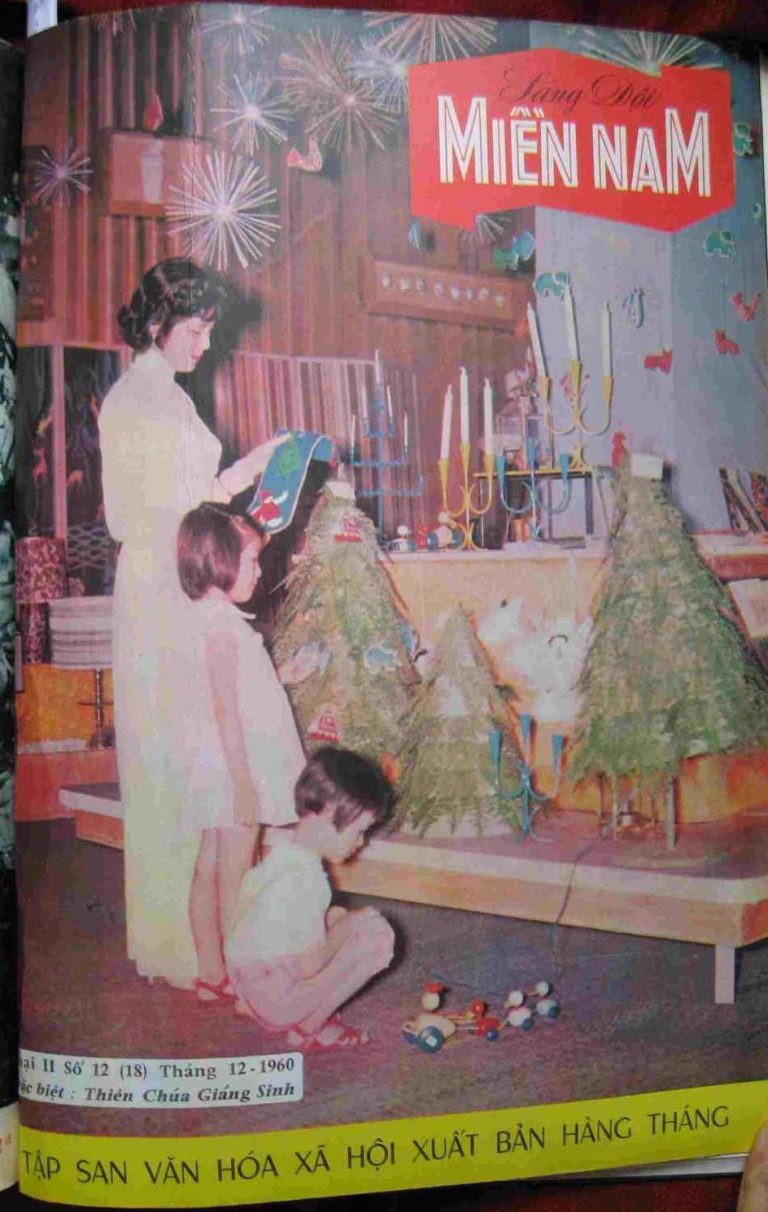
Sáng dội Miền Nam 12 (December 1960)
Of course, Christmas was and is a religious holiday for Vietnamese Christians, the majority of which have historically been Catholic. Catholic periodicals in the RVN published their own themed issues every December, and the tone was often solemn and pious. Below is the cover from Our Lady of Perpetual Help (Đức Mẹ hằng cứu giúp) for its December 1959 issue. Our Lady of Perpetual Help was the official publication of the Catholic lay association, the Legion of Mary. The cover shows a stylized illustration of the Holy Family, with Mary and Joseph depicted as a Vietnamese couple dressed in traditional clothes. Mary gazes at the baby Jesus with both love and devotion, while Joseph seems somewhat surprised at the miraculous birth. Unlike the cover of The Bright Shining South, there is no holiday décor or presents, and the image conveys a quiet, meditative joy rather than a fashionable celebration.
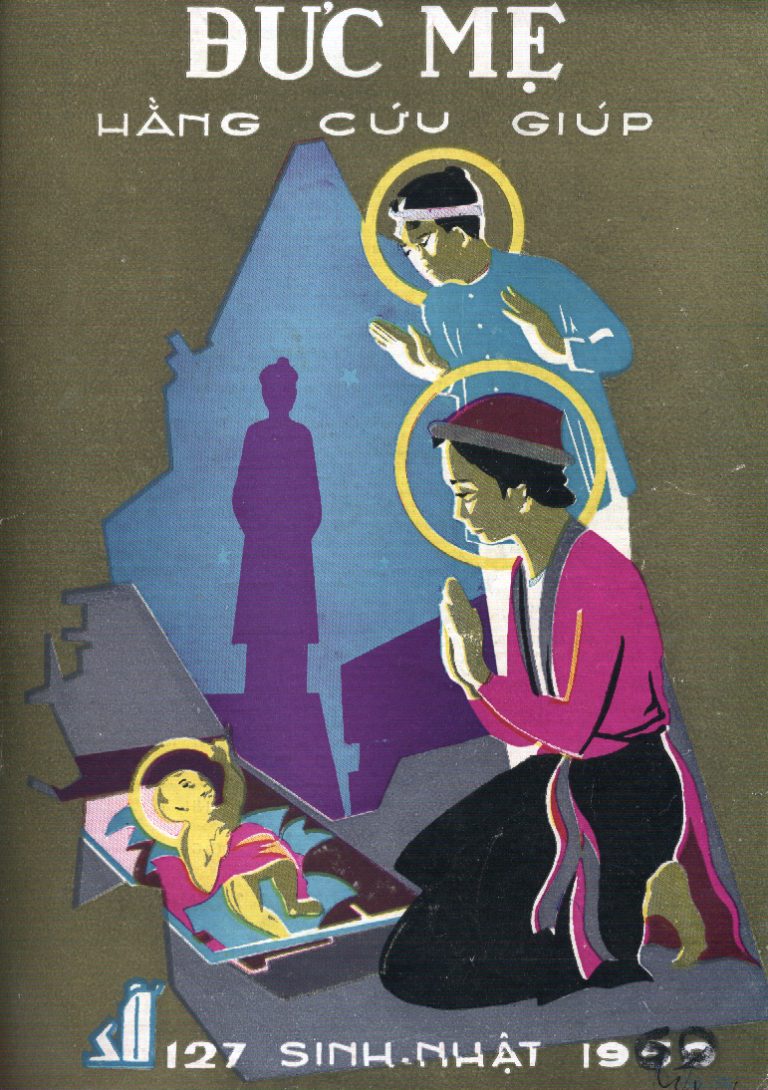
Đức Mẹ hằng cứu giúp 127 (Dec 1959)
Under Ngô Đình Diệm’s rule, Christmas also came with a side of politics because the RVN’s first president allowed Catholicism to play a prominent role in public life. In doing so, he politicized his own religion, whether wittingly or not. Diệm gave his faith greater public prestige and funneled (or let others funnel) a larger share of government resources towards Catholicism than towards other religions. He chose a lay Catholic philosophy called personalism to be the regime’s official ideology and allowed his older brother Bishop Ngô Đình Thục to direct an ideological training center for civil servants. Diệm also gave Bishop Thục a seat of honor during public ceremonies. The government celebrated Catholic holidays with great fanfare and sponsored pilgrimages to Marian shrines. At the local level, Catholic military commanders ordered their soldiers to help build churches, and unscrupulous Catholics claimed membership in Diệm’s secret political party or used their religious identity to extract bribes and favors.1 The ostentatious display of religiosity peaked in the early 1960s and only benefitted elite Catholics, yet it increasingly irritated many non-Catholics who became ever more convinced that Diệm’s government practiced religious discrimination.
The last image is the broadcast schedule of the Voice of the Republic of Vietnam, the RVN’s official radio station (also known as Radio Saigon or Radio Vietnam), for Christmas 1962. I found this schedule in National Revolution (Cách mạng quốc gia), the official newspaper of Diệm’s mass political party, the National Revolutionary Movement (Phong trào Cách mạng Quốc gia), which was distinct from his clandestine party. Notice that the schedule interspersed the regular programming of news (tin tức), radio fiction (đọc chuyện), classical Vietnamese music (cổ nhạc), and contemporary music (tân nhạc) with religions sermons (bài giảng), ringing church bells, Catholic hymns (thánh ca), special programs by churches and Catholic organizations in Saigon, and an anticommunist holiday message aimed at North Vietnam, entitled “Sharing stories with our Northern compatriots on Christmas – Messages from behind the Iron Curtain” (“Câu chuyện cùng đồng bào miền Bắc nhân dịp Giáng sinh – Sau bức màn sắt nhắn tin,” at 22:50 on Dec 25). In particular, Diệm’s official presidential address for the holiday (“Thông điệp của Tổng Thống VNCH nhân dịp Giáng sinh”) was on heavy rotation throughout December 24 and 25. In contrast to the cover of Our Lady of Perpetual Help, the regime’s official Christmas broadcast was not just religious but explicitly political, reflecting Diệm’s intertwining of Catholicism with the government. Together, the three primary sources reflect the different facets of Christmas in the RVN.
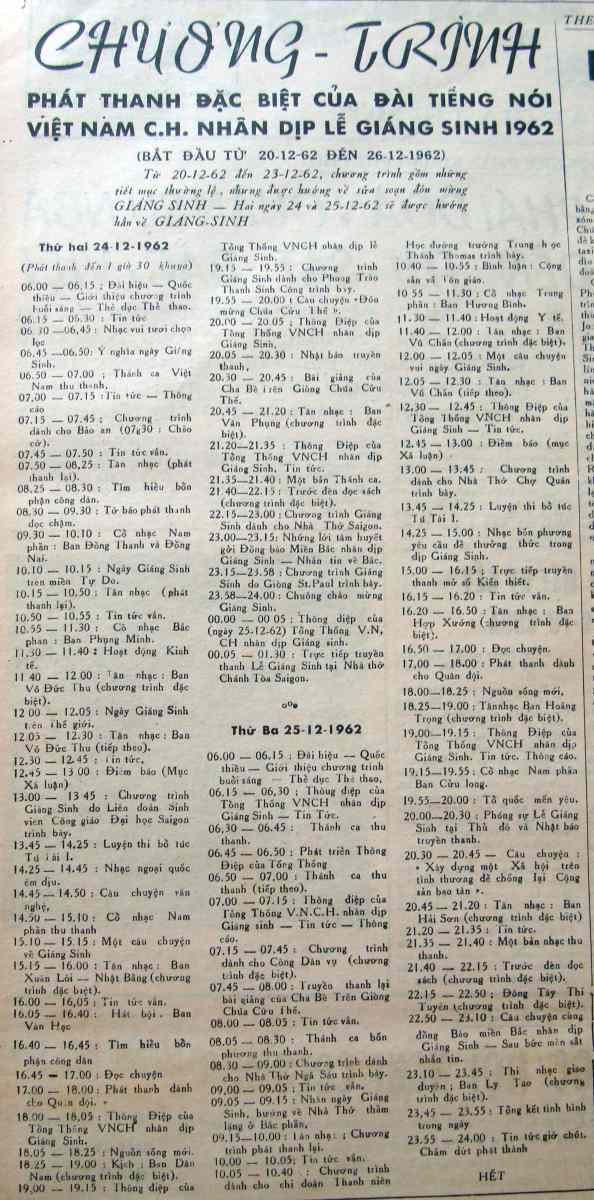
“Chương trình Phát thanh đặc biệt của Đài Tiếng nói Việt Nam Cộng Hòa nhân dịp lễ Giáng Sinh 1962,” Cách mạng Quốc gia 1350 (23-24 December 1962): 2.
1 Piero Gheddo, The Cross and the Bo-Tree (New York: Sheed and Ward, 1970), 145-148.
President Ngô Đình Diệm’s address on the occasion of the 1962 Christmas happened to have been discussed by the French Ambassador in Saigon in a report to the Ministry of Foreign Affairs in Paris dated January 10, 1963.
The Ambassador both attached the French translation of that address to his report and situated it against the backdrop of the success that the Strategic Hamlet Program appeared to have accomplished in the war against the Việt Cộng. He pointed out that its main take-away was President Diệm’s intent to induce the defection of Communist rebels through a politics of clemency.
The Ambassador wrote: « Le Département trouvera ci-joint le texte du message lancé par le Chef de l’État à l’occasion de Noël.
L’idée essentielle à retenir est que, pour la Présidence, le moment est venu d’encourager le ralliement des Vietcong par le pardon : “La charité veut que ceux de nos frères que séduisirent des propagandes trompeuses soient accueillis, s’ils nous reviennent, dans l’oubli de leur égarement passager.”
Le Président Diệm m’a indiqué à ce sujet que, depuis la création des hameaux stratégiques, les ralliements des jeunes Vietcong étaient plus fréquents et plus nombreux, les intéressés sachant que leurs familles étaient en relative sécurité dans ces hameaux et non plus exposées aux représailles des dissidents si eux-mêmes désertaient le camp de la rébellion. »
The Ambassador’s report as well as the French translation of President Diệm’s address can be accessed via this link:
https://www.flickr.com/photos/168630084@N05/49747065388/in/dateposted-public/