
Wedding season is just around the corner in the US, and every wedding season makes me think of my own wedding years ago. I wanted my wedding to reflect Vietnamese tradition, but as a historian, I knew that there was no such thing as a single, timeless tradition and that practices change over time in response to geographical, social, economic, and political conditions. Moreover, no single wedding could encapsulate an entire body of customs and rituals. And so I found myself using my historian’s brain to figure out how I wanted to interpret and adapt Vietnamese wedding traditions for myself.
Most ethnic Vietnamese associate the “traditional wedding” with certain folk customs that had become conventional by the 20th century. In this post and the next one, I identify a few defining characteristics of Vietnamese marriage patterns and relate them to Vietnamese history and culture more broadly.
First, Vietnamese marriages have historically been patrilocal, meaning married couples tended to reside with or near the husband’s family. Historians think that this pattern dates back to the earliest period of Vietnamese history. The Red River delta in northern Vietnam is the cradle of Vietnamese civilization, and most historians believe that the prehistoric society of the delta practiced matrilocal residence, in which married couples lived with or near the wife’s family.1 However, the Han Chinese empire conquered the Red River delta in 111 BC and introduced the Han custom of patrilocal residence. The change favored men over women, as women now depended on their husband’s families rather than their own. The delta remained part of the Chinese empire for the next millennium, a period colloquially known as the “1000 Years of Northern Domination” (111 BC-939 AD), and marriage customs in Vietnam permanently shifted to become more patriarchal.
If patrilocal residence disfavored women, the practice of bride price or bridewealth somewhat served as a counterbalance. Bride price is a custom in which the groom and his family provide money or betrothal gifts to the bride’s family. In addition to gifts, the prospective groom might also live temporarily with the bride’s family before the wedding and perform labor for them, a practice known to researchers as bride service and that Vietnamese people refer to as tục ở rể (literally, the “custom of living as a groom”). Researchers think the practice of bride price and bride service emerged as a way of compensating the bride’s family for the loss of her labor when she relocated to live with her husband and reflects the value that a society placed on young, unmarried women.2 Bride price stands in stark contract to the custom of dowry, in which the bride’s family must offer money or gifts to the groom’s family. In societies that practice both dowry and patrilocal residence, daughters are a net economic loss insofar that parents raise daughters only to lose their labor and pay for their departure upon marriage. But the practice of bride wealth partially neutralizes the economic loss to the bride’s family that is inherent to patrilocal residence, and a high bride price is often a sign of a family’s social standing or the bride’s desirability. The custom of bride price is common not just in Vietnam but across Southeast Asia and China.
Perhaps the most famous example of bride price in Vietnamese culture comes from the myth of the Mountain Spirit and the Water Spirit (sự tích Sơn Tinh Thủy Tinh) found in Departed Spirits of the Việt Realm (Việt điện u linh tập), a collection of supernatural tales about local spirits compiled in the 14th century by Lý Tế Xuyên.3 In the mythic past, before the “1000 Years of Northern Domination,” there was a kingdom in the Red River delta ruled by a line of kings named Hùng. The king had a beautiful daughter named Mỵ Nương, and both the Mountain Spirit and the Water Spirit proposed marriage. The king was impressed with the two suitors and, observing the custom of bride price, agreed to marry the princess to whichever man arrived first with betrothal gifts. The Mountain Spirit proved quicker, and he married his bride and whisked her back to the mountains. The Water Spirit arrived late, grew angry that he could not marry the princess, and attacked his rival with floods and storms. The supernatural love triangle is the origins of the monsoon rain in northern Vietnam.
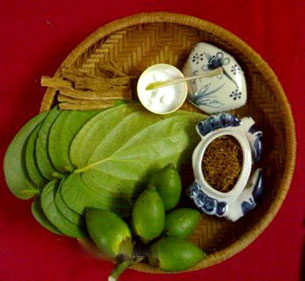
The most common betrothal gift reflected the cultural practice of betel chewing (ăn trầu), common in Vietnam and across South and Southeast Asia as well as parts of Oceania. When the nut of the areca palm, the leaf of the betel plant, and lime paste are chewed together, it produces a mild sensation of stimulation – sort of a light buzz. Betel chewing produces a red paste that users must spit out afterwards. The practice was a social lubricant similar to the consumption of coffee and tea in modern society. People thought of betel chewing as something that facilitated conversation. Hosts provided guests with areca nuts and betel leaves, and it appeared at virtually all social gatherings. Betel chewing was especially associated with marriage, and it was almost always included among the betrothal gifts from the groom’s family. There is a famous folktale about the origin of betel chewing found in the Arrayed Tales of Collected Oddities from South of the Passes (Lĩnh nam chích quái),most likely compiled in the 14th century. Also set in the mythic past before the “1000 Years of Northern Domination,” it describes a quasi-love triangle involving two brothers who closely resembled each other. Both brothers fell in love with the same young woman, and her parents married her to the elder brother. The younger brother felt neglected and left home. He later died of grief in the wilderness and turned into an areca palm. The older brother went searching for his younger brother, also died in the wilderness at the same location, and transformed into a stone that was entangled in the roots of the areca palm. The wife longed for her husband. She, too, wandered to the same location and died of grief, and she turned into a betel vine that clung to the areca palm and the stone. The local people admired the affection and righteousness of the brothers and the wife and built a shrine to them. Later, when the king visited the location, he chewed the nut of the tree together with the leaves of the vine and then spat out the remains on the stone. He burned the stone and combined it with the nut and leaves and so enjoyed the taste that he ordered the people to cultivate areca palms and betel plants. The story ends by explaining that betel chewing became part of the marriage ceremony.4
Image credit: stylized tray of areca nut, betel leaves, and lime paste found at https://www.caidinh.com/trangluu1/khoahockythuat/traucau.htm
- Keith Taylor, A History of the Vietnamese (Cambridge: Cambridge University Press, 2013), 15. ↩︎
- Jane Monnig Atkinson and Shelly Errington, Power and Difference: Gender in Island Southeast Asia (Stanford: Stanford University Press, 1990), 3. ↩︎
- For an English translation, see “The Mountain Spirit,” trans. Brian Ostrowski and Brian Zottoli, in Sources of Vietnamese Tradition, ed. George Dutton, Jayne Werner, and John K. Whitmore (New York: Columbia University Press, 2012), 19-20. ↩︎
- See Liam Kelley, trans., Arrayed Tales of Collected Oddities from South of the Passes, I/27b, https://sites.google.com/hawaii.edu/viettexts/lncqlt/lncqlt-1. ↩︎
Pingback: 8. WHEN HISTORIANS GET MARRIED: HISTORICALLY-INSPIRED DRESS, HAIRSTYLE, AND JEWELRY ON MY WEDDING DAY – Canh Than
Pingback: 9. WHEN HISTORIANS GET MARRIED: SOURCES AND READINGS – Canh Than