
Chúc mừng năm mới! Happy New Year!
In the first part of this two-part post, I described the practice of making an offering to the Kitchen God a week before Lunar New Year and how I learned the ritual from my parents. As I prepared for the holiday this year, I thought back to a picture that I drew of the Kitchen God when I was about ten years old, and I dug through my stash of mementos to find it. That drawing never fails to make me chuckle because it expresses my childish conception of the Kitchen God. But this time, it also made me reflect on the process of cultural transmission, that is, the passing down of cultural ideas and practices from one generation to the next. Building on the previous post, I consider my personal experience with the passing down of this ritual. I grew up outside of Vietnam as part of the Vietnamese diaspora, and my experience learning about rituals such as the worship of the Kitchen God reflected the specific conditions of diasporic cultural transmission.
In my experience, one of the peculiarities of passing down cultural ideas and practices in the diaspora was the narrowness of my exposure to Vietnamese culture, including such rituals like the worship of the Kitchen God. Although there was a sizeable Vietnamese community in the greater Seattle area where I grew up, very few Vietnamese lived in my neighborhood. I watched my mom make offerings to the Kitchen God, but I never saw anyone else do it. Neither did I ever hear anyone at school talk about it. I don’t think any of my classmates ate thèo lèo cứt chuột candy or ché trôi nước sweet pudding. A few Asian grocery stores sold seasonal items associated with the Kitchen God, but none of the mainstream grocery stores in my neighborhood did. There was also no mention of the Kitchen God on American television or in English-language children’s books. In short, the worship of the Kitchen God like so many of my family’s rituals was a strictly private affair, largely circumscribed by the walls of our house and learned exclusively from my parents.
In contrast to my limited exposure to Vietnamese rituals, American customs were so ubiquitous that it was practically in the air that I breathed. For example, my family did not celebrate Easter, but I learned about Easter customs because I was surrounded by them every spring. Pastel-colored bunnies, chicks, and eggs seemed to appear everywhere in the weeks leading up to the holiday. Grocery stores were flooded with baskets of plastic grass and chocolate eggs, and local churches and community centers advertised Easter egg hunts. At school, my class often did Eastern-themed art projects, and the school librarian or teacher read us picture books about the Easter bunny. Even at home, I might watch after-school Easter specials of my favorite TV shows. The magical bunny didn’t visit my family, but I was bound to hear about it from my friends the next day as they shared their chocolate bounty and munched on oddly colorful hardboiled eggs. Easter may not have been my holiday, but it was the holiday of everyone else around me.
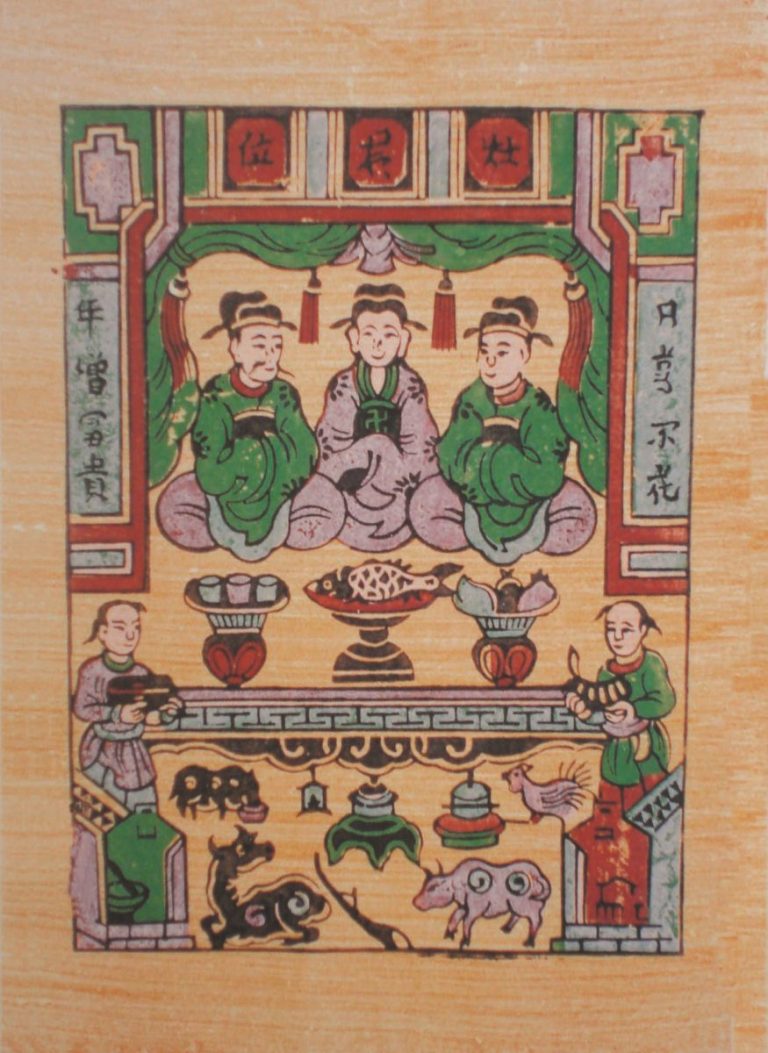
My family was always keenly aware of just how weird it was to celebrate customs like the worship of the Kitchen God in America. In my parents’ own childhood, their families used a traditional Vietnamese clay stove with charcoal as fuel, but my sibling and I grew up with a modern American kitchen, complete with an electric range, a large enclosed oven, and a microwave. My parents always joked that we should make an offering not just to the Kitchen God but the Microwave God as well. Rather than a carp or a horse, perhaps he needed a Chevrolet to take the freeway to heaven! More importantly, there was a certain loneliness in sending off the Kitchen God knowing that no one else in our neighborhood was sending off theirs. I never had any hankering to celebrate Easter, but I often wished that my neighbors, teachers, and classmates shared my family’s holidays and rituals.
While I was surrounded by pictures of the Easter Bunny, I don’t think I ever saw an image of the Kitchen God until I was in my late teens, when the Vietnamese-American community and media had grown larger. My parents told me stories about the trinity of the Kitchen God – two gods and a goddess – but we didn’t display any images of this trinity in our home and never bought joss paper depicting the gods. Nor did we have a permanent altar or even any small statues of the Kitchen God. My family was Buddhist, and we only had images and statues of various buddhas in our house. As a result, I didn’t have a clue what the Kitchen God looked like. Or rather, I had no idea how Vietnamese people depicted the trinity of gods visually. What did they wear? Did they ride the same horse or carp to heaven or did they each need a separate one? How exactly does one ride a fish anyways? What did their memorial to the Jade Emperor look like? What did the Jade Emperor look like?
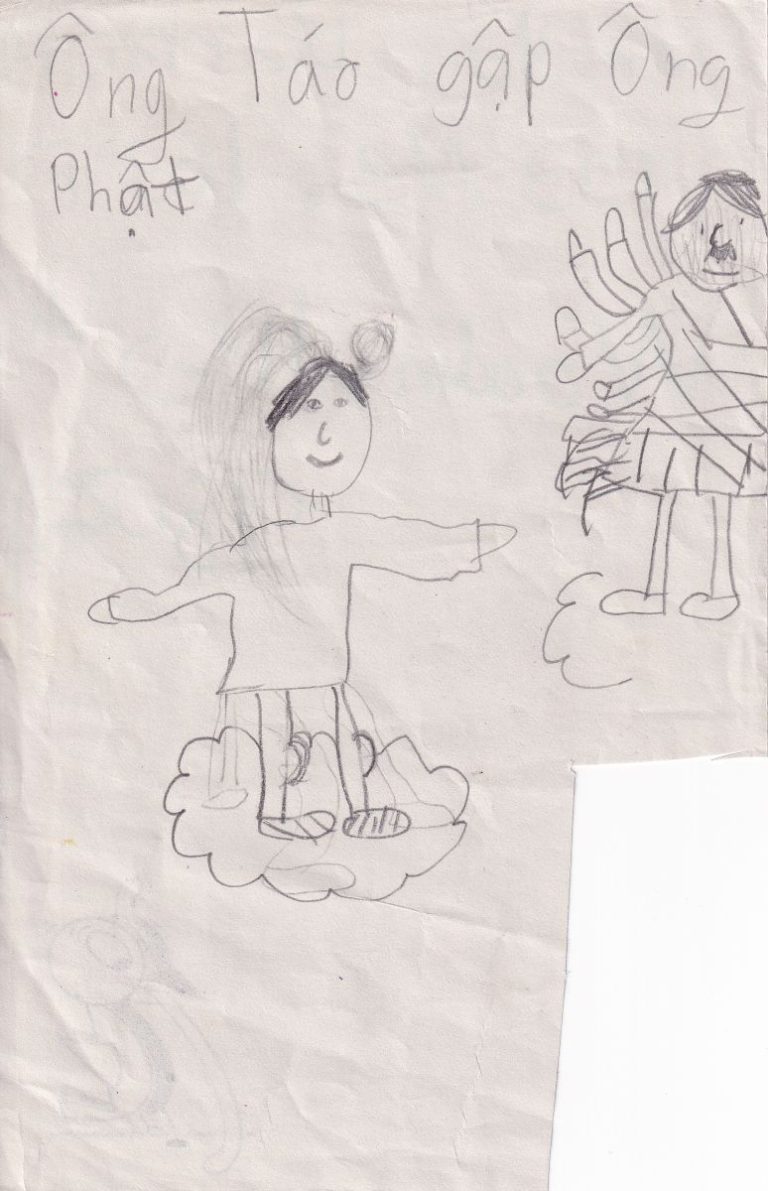
Without a robust Vietnamese media or surrounding community of worshippers, I filled in the blanks with my own imagination. And that brings me to my childish drawing of the Kitchen God. Scrawled on some scrap paper, it’s entitled, “Mr. Kitchen God Meets Mr. Buddha” (“Ông Táo gập ông Phật”), and reflects a mish mash of my American upbringing and my family’s customs and stories. (I misspelled gặp, “to meet,” as gập, “to fold.”) My Kitchen God is singular rather than a trinity and wears an oversized shirt without any pants, just like dad always said. Instead of preparing a memorial for the Jade Emperor, my Kitchen God is reporting to the Buddha, who sports a Charlie Chaplin mustache and has a bunch of arms. We had a beautiful silk painting of the Buddhist deity of compassion, Quan Âm (Ch. Guanyin), who is depicted as female and as having numerous eyes to see all suffering and numerous hands to assist all those who suffer. So I must have decided to give my Buddha a bunch of arms just like Quan Âm but then decided that he needed a mustache to indicate that he was male. Both my Kitchen God and the Buddha are floating on fluffy white clouds, which was undoubtedly influenced by pictures of angels walking around on clouds in an imagined Christian heaven that I often saw growing up in America. The unintentionally comical mishmash of influences reflects the limited exposure, cultural borrowing, and adaptation that is common in diasporic cultural transmission.
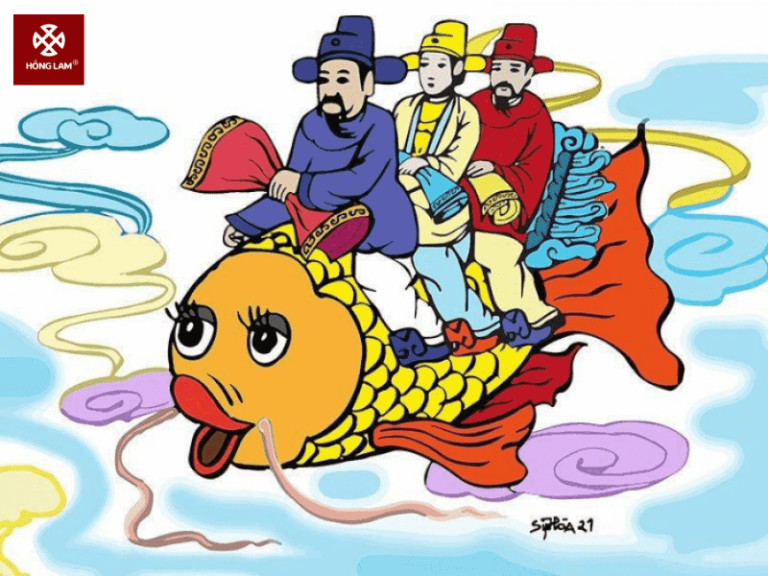
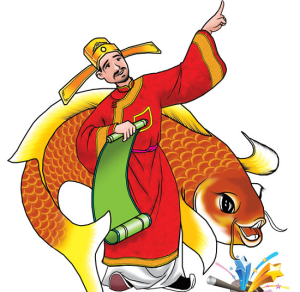
I don’t think I fully appreciated the peculiarities of cultural transmission in the Vietnamese diaspora until I moved to Saigon as an adult to conduct dissertation research. Just as bunnies, chicks, and eggs were inescapable very spring during my American childhood, thèo lèo cứt chuột and chè trôi nước appeared at every open-air market in Saigon a week before the lunar new year, reminding me that it was once again time to propitiate the Kitchen God. It made me realize how different my experience of the ritual would have been had I grown up in Vietnam. I would have seen joss paper for sale in the shape of horses, carps, and traditional mandarin robes, hats, and shoes, not to mention more modern gifts like joss paper motorbikes. Even if my family didn’t burn joss paper, the people around me would have. In local shops and private homes, I might have seen traditional and contemporary images of the three gods dressed in mandarin robes and riding on horses or carps, amidst those curly “auspicious clouds” that are typical in East Asian art rather than the fluffy ones found in Western art. As I grew older, I would have read the special holiday issues of newspapers and magazines that included a review of events of the past year next and images of a singular Kitchen God holding an unfurled scroll, ready to submit his memorial to the Jade Emperor. I would also have watched holiday performances and television programs that incorporated the Kitchen God as a character or the mythology of the Kitchen God into the plot. I certainly would haven’t been the only child in class snacking on thèo lèo cứt chuột candy, and all of my friends would have known what chè trôi nước dessert pudding was.
Yet at the same time, there’s also a lot I wouldn’t have learned had I grown up in Vietnam. In a place where my family’s customs were mainstream rather than exotic, it would have been almost effortless to carry on the tradition of worshiping the Kitchen God, so much so that I would have taken it for granted. I wouldn’t have experienced the difficulties that diasporic populations face when trying to preserve their culture. I wouldn’t have known how hard it is for a child to make sense of customs that seem utterly out of place and that are learned exclusively at home. I wouldn’t have appreciated the single-minded determination of refugee parents who insist on passing down their culture without any support from schools or the surrounding community. Nor would I have understood the profound grief of parents whose children reject such traditions. Most of all, I wouldn’t have intuitively understood the resilience that ethnic minorities everywhere must possess if they are to retain their distinctiveness. Growing up in the diaspora, I learned from a young age that cultural transmission requires extraordinary effort, and it is that effort that endows the passing on of tradition with a special meaning, a meaning that is hard for comfortable majority communities to ever fully grasp.
IMAGE CREDIT
The featured image of chè trôi nước can be found here: https://moshimoshi.vn/bay-cach-dua-ong-tao-ve-troi-cuc-chuan-de-nam-moi-nhieu-tai-loc.
The “traditional” image of the Kitchen God trinity is a Đông Hồ-style painting. Đông Hồ is a village in the upper Red River delta in northern Vietnam, and it is famous for a distinctive style of folk painting. I found this particular Đông Hồ-style painting on the internet and cannot vouch for its origins or authenticity. It can be found here: https://moshimoshi.vn/bay-cach-dua-ong-tao-ve-troi-cuc-chuan-de-nam-moi-nhieu-tai-loc.
Contemporary image of the trinity of gods riding a carp can be found here: https://honglam.vn/nguon-goc-y-nghia-ngay-tet-ong-cong-ong-tao?srsltid=AfmBOorCiMs8zAoZhbQddUOn6YyFPXwmvWpOM3Xg8DCGE6wlpN90Rldz.
Contemporary image of the Kitchen God with a scroll: https://hoavienchanhphuhoa.com/tai-sao-ong-tao-lai-cuoi-ca-chep-ve-troi/.