
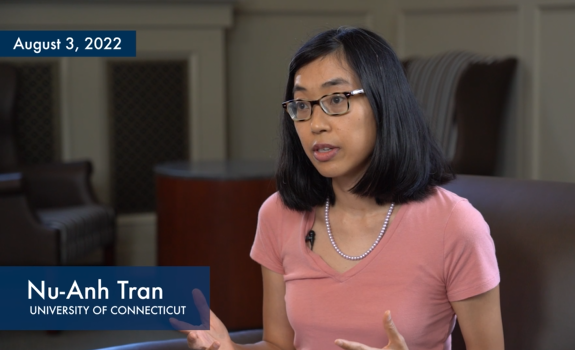
This post marks a new irregular series about professional work that is outside of my regular research and teaching but that are still informed by my academic training. I think of it as fun, cool, creative things that I get to do as a history professor now that I’ve received tenure. Of course, teaching my students and doing research are pretty fun too, but these side projects are unusual one-offs, which makes them special in a different way.
A few years ago, I worked on a series of teaching videos about the Vietnam War for the Choices Program. Choices, formerly housed at Brown University, produced free and paid curriculum materials for K-12 schools, and they were working on a unit on the Vietnam War.
I was incredibly excited to receive the invitation. As a grumpy teenager, I had been deeply dissatisfied with the way the Vietnam War was taught to me in school. I resented that instruction on the topic seemed to always be about American soldiers, politicians, and antiwar protesters. To the extent that my junior high and high school textbooks mentioned Vietnamese people at all, we were portrayed in a simplistic cardboard figures who didn’t seem to have complex political ideas or motivation. The cast of characters included a corrupt dictator named Ngô Đình Diệm, a nationalist minded communist named Hồ Chí Minh, an undifferentiated mass of patriotic and heroic peasants, and some pitiable refugees who left their homeland because they had some connections to the Americans. Looking back, I know my history teachers did their best with the materials they had. I know I had the most amazing, dedicated teachers a student could ask for, and I wouldn’t have become a historian without their encouragement and generosity. But during those specific classes on the Vietnam War, it felt like they were joining their voices with the rest of American society to tell me that Vietnamese people, especially refugees like my family, didn’t deserve to be the main characters of the great historical event that had transformed our lives.
I became a historian of Vietnam in part because I wanted to do the research that would facilitate better teaching about the war. Once my career was more advanced, I began to think more seriously about curriculum development, and I spoke spoken at a few local teaching workshops aimed at K-12 teachers. The invitation from Choices marked a decisive pivot towards curriculum development, and those teaching videos are some of the coolest things I have ever done as a professor.
Here’s how the process worked. The people at Choices gave me a series of questions about a month in advance, and I spent a few weeks composing answers based on the best scholarship. I had all the answers typed up in bullet points, and I reorganized them until I felt they were clear. I also practiced them, similar to how I had practiced for interviews when I was on the job market. Then, the Choices people came to my campus to film. We filmed each question individually, and I reviewed my notes for each one just prior to filming it. The final version of the videos look so polished that you might think I answered every question in one take with perfect fluency. Dear reader, I assure you that I did not! I am a professor, not an actor or news anchor, and I trip on my words just as much as the average person. Sometimes, we did multiple takes when I suddenly blanked or wasn’t sufficiently clear. It wasn’t unusual to break a single question in multiple parts and film the parts separately or rerecord a particular section because I tripped on my words. At one point, a helicopter flew overhead, and the video caught the sound of the propellers, so we had to redo a couple of sentences. The Choices People coached me on looking at the camera and finishing each question with a pause, which I think made it easier for them to edit. Afterwards, during the editing process, they added images, diagrams, and outlines. They were kind enough to let me review each video before posting them online. Although I was quite proud of the finished product, I couldn’t help but notice that I seemed to bounce a lot during every video! Choices’ unit on the Vietnam War later won a prize from the Association for Asian Studies.
Those teaching videos led to new opportunities for me. I reviewed the Choice Program’s textbook on the Vietnam and received invitations to speak at more teachers’ workshops. Working on those videos also spurred me to turn my attention to producing more teaching materials, and I co-edited a special issue of the Journal of Vietnamese Studies dedicated to translations that teachers can use in the classroom.
So I was shocked and saddened last spring when Brown University severed its tie with Choices, shut down the program, and scrubbed the website of the teaching videos, including the ones that I had worked on. The ostensible reason is financial, but critics complain that the closure had to do with current politics. The program had been around for decades, and there were educators in every state using their materials. Some teachers were scrambling to buy or download materials before the closure. I wanted to my teaching videos here to mark the start of a new academic year, especially as they are no longer available on the Choices Program website. It’s not the same without the videos that other researchers contributed, but it’s what I have. There are no blooper reels, but maybe you can spot the places where I messed up and had to be redone.
Pingback: TEACHER’S GUIDES: AN INTRODUCTION – Canh Than