
I’ve always been fascinated by the maps in academic books, but I never gave much thought to where they came from or who drew them until I wrote my first book. What I discovered was that every map in my book would require a mini-research project of its own. This post is the last one in the series about my experience writing my first book.
Similar to photos, maps are costly for both the author and the publisher. Most authors must hire a cartographer to draw custom-designed maps, unless they have the ability to draw the maps themselves. On the side of the publisher, it is more costly to print images, and publishers will typically include a clause in the book contract imposing an upper limit on the maximum number of maps.
My initial step was to decide how many maps I wanted to have and what I wanted them to show. Like many other authors, I wanted a basic political map showing major cities, provinces, and geographical features mentioned in the book. Even more importantly, my book is about the anticommunist political opposition in the Republic of Vietnam (RVN, or South Vietnam) under the rule of Ngô Đình Diệm, and I wanted to include a few maps to help readers locate place names and visualize the geographical dimension of the anticommunist opposition. With all that in mind, I asked the publisher for three maps: southern Vietnam in 1955, central Vietnam in 1955, and all of the RVN in 1956. Fortunately, my editor at the University of Hawaii Press readily agreed, and my book contract specified that the book would contain up to three maps.
Then, I had to find a cartographer and the funds to pay him or her. As mentioned in the previous post, colleagues suggested that I budget $2000 to $3000 for images, of which about $600 to $800 should be devoted to maps, and my institution kindly provided me with the funds. I reached out to the wonderful mapmaker Erin Greb whom other academics had recommended. I described the three maps I had in mind, and I must have breathed a sigh of relief when she priced them within my budget. Now, a cartographer’s job is to draw the maps based on the author/customer’s specifications, and the latter might ask to include rivers, mountains, provincial boundaries, cities and towns, battles, etc. However, the cartographer is not an expert on all of those features. For example, Erin could correctly add cities and towns to the maps, but she didn’t necessarily know the exact location of the RVN’s provincial boundaries in a given year, not least because those boundaries changed so frequently. Nor did she know the location of the sectarian autonomous zones. Thus, it was my job to provide her with existing maps to serve as sources, and finding source maps send me down rabbit hole after rabbit hole.
CHASING DOWN THE FIRST RABBITS: SOUTHERN VIETNAM IN 1955
I decided that two of my three desired maps would be for Chapter 2, which covers the military conflicts between Diệm and his rivals in 1955-1956. His greatest rivals in southern Vietnam were the so-called sects, that is, anticommunist organizations who fought against the communists during most of the Resistance War (1945-1954, Kháng Chiến Chống Pháp, known in the West as the First Indochina War with the different date range of 1945-1954). The sects included the Tây Ninh-based Cao Đài religious group, the Hòa Hảo Buddhists in the Mekong delta, and the Bình Xuyên river pirates in parts of Saigon and the riverine region southeast of the city. Although allied with the government in Saigon, the sects controlled large autonomous zones in southern Vietnam, and I wanted the map to show the location of these zones. I also wanted it to include the provisional assembly areas of the (communist) Democratic Republic of Vietnam. The Geneva Accords of 1954 ended the Resistance War and divided the country at the 17th parallel into two regions soon be known as North and South Vietnam. The DRV was to regroup its political and military personnel to the North, and the French and French-supported State of Vietnam (later renamed the Republic of Vietnam) were to regroup their forces to the South. Regroupment took place in stages, with both sides initially withdrawing to provisional assembly areas and then departing from there to either North or South Vietnam. In southern Vietnam, the DRV’s provisional assembly areas were located in communist strongholds on the Point of Cà Mau, the Plain of Reeds, and the Hàm Tân-Xuyên Mộc area in the southeast. My first map would focus on southern Vietnam and illustrate both the expanding power of the sects and the diminishing power of the DRV in 1955. In fact, Chapter 2 explains that the some of the DRV provisional assembly areas quickly became the object of military contestations between Diệm and the sects once the DRV withdrew to the North.
To provide Erin with source maps, I began looking at recently published books about the Diệm period. Edward Miller’s Misalliance includes a minimalist map that only indicates the sects’ headquarters in 1954-1955, Jessica Chapman’s Cauldron of Resistance has a map that shows sectarian zones in 1954, and David Biggs’ Quagmire included a map that illustrated both sectarian zones and DRV military zones during the Resistance War.1 All three maps were in agreement, but where did they get their information? I eventually traced Chapman’s and Biggs’ sectarian zones back to a much a older map in Bernard Fall’s “The Political-Religious Sects of Viet-Nam” (1955).2 Fall’s map illustrates the greatest extent of the sectarian zones in April-June 1955, and I managed to find similar maps of Cao Đài and Bình Xuyên zones for the same date range as Fall’s online. These latter maps were from the series, Selected Groups in the Republic of Vietnam, published in 1966 by the Special Operations Research Office of American University. The series consisted of studies conducted under contract with the US Department of the Army, though both the 1966 maps and Fall’s were probably based on French military maps from 1955. Later, I was able to verify Fall’s map and the 1966 maps against a French military map from 1955, reproduced in Pascal Bourdeaux’s disseration, “Émergence et constitution de la communauté du bouddhisme Hòa Hảo.”3
Having caught the rabbit at the bottom of this hole, I turned my attention to finding a source map of the DRV’s provisional assembly areas. I eventually found one in Anita Nutt’s Regroupment, Withdrawals, and Transfers – Vietnam, 1954-1955 (1969), published by the Rand Corporation.4 In the end, I gave all of the maps mentioned above to Erin, and she created a beautiful new one showing both sectarian zones and provisional assembly areas.5
MORE RABBITS, MORE HOLES: CENTRAL VIETNAM AND PROVINCIAL BOUNDARIES
Chapter 2 of my book also covered the contest between Diệm and the anticommunist political parties in central Vietnam, and my envisioned second map was to depict the location of these rebellions. As I could not find any maps showing the rebels’ zone of influence, the best I could do was to have the map indicate the affected provinces and the rebel bases. Therefore, it was necessary to show provincial boundaries. But it proved incredibly difficult to come up with a source map of 1955 provincial boundaries. Diệm’s government redrew boundaries and renamed provinces and districts several times throughout his rule, and that significantly changed the political map of the southern half of the country. Much to my surprise, none of the recent book-length studies on the Diệm period included any maps showing provincial boundaries at so early a date. If they showed provincial boundaries at all, it was based on the 1960 boundaries, such as the map found in Geoffrey Stewart’s Vietnam’s Lost Revolution (2017).6 I perused old publications in hopes of finding a map with provincial boundaries and stumbled upon a foldout map of French Indochina from Donald Lancaster’s Emancipation of French Indochina (1961). Based on the names of the provinces shown in the Lancaster map, I confirmed that it showed provincial boundaries of the State of Vietnam during the Resistance War. I also found an old CIA map of French Indochina depicting the 1951 boundaries.7 As far as I could determine, provincial boundaries were not redrawn between between the early 1950s and 1955. Using these two maps and additional information provided by me, Erin produced the only map to depict the rebellions in central Vietnam. It’s also the only map published within the last few decades that I know of to show the region’s 1955 provincial boundaries.8
Lastly, I wanted a map showing all the provinces of the RVN in 1956 after Diệm completely redrew provincial boundaries, and that proved no less difficult. I have never found such a map in any archival document or historical publication, and as stated above, recent books usually only included a map of 1960 provincial boundaries. What to do? Eventually, I discovered that the Cornell University Library holds several old maps produced by the RVN, and I requested scans of two maps from their catalog. They managed to send me these scans just before the pandemic shut down their library.
The only catch was that I didn’t know when these maps were created and if they reflected the 1956 boundaries or those of some later date. To be sure, these maps were dated in the library catalog, but the maps themselves bore not date, and I had to verify the date of these vintage maps in order determine out if any of them could be used as a reliable sources. Not sure where else to look, I thumbed through the CIA reports that I had collected from the National Archives and Records Administration in College Park, Maryland. These reports summarize weekly developments in the RVN, including the creation of new provinces. Triangulating CIA reports and the historical maps, I was able to pinpoint the date of one particular map to 1956-1957.9 I had finally found my last rabbit at the bottom of the last rabbit hole. Once again, using the 1956-1957 Cornell map as a source, Erin produced the only map published within the last few decades that I know of to show 1956 provincial boundaries in the RVN.10
Ultimately, the search for reliable source maps proved to be an adventure of its own, quite apart from the drafting of the manuscript and unlike any other research I have ever done. I didn’t design any of the maps, but I played a significant role in supplying the information necessary for their creation. It was also a process made possible by the financial support of my institution. Most of all, it was amazing to watch a cartographer design maps just for me. Some people like to own bespoke clothes and shoes, but what’s that compared to the joy of three bespoke maps?
TECHNICAL STUFF
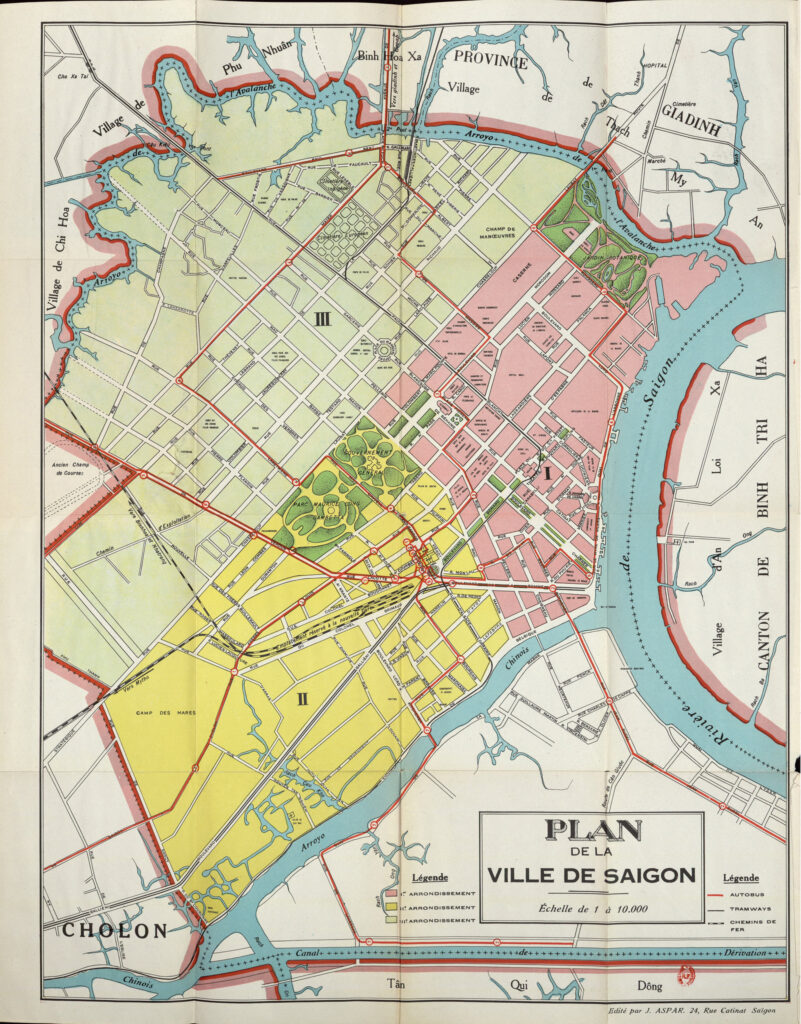
Image credit: Vintage map of Saigon from 1942, found at https://saigoneer.com/saigon-heritage/2400-these-11-wonderful-old-maps-show-the-evolution-of-saigon-and-cho-lon
NOTES
- I am not including the original maps from any book out of respect for copyright restrictions, but several of them can be found online through Google books. See Edward Miller, Misalliance: Ngo Dinh Diem, the United States, and the Fate of South Vietnam (Cambridge: Harvard University Press, 2013),unnumbered page before page 1; Jessica Chapman, Cauldron of Resistance: Ngo Dinh Diem, the United States, and 1950s Southern Vietnam (Ithaca, NY: Cornell University Press, 2013), xiv, map 1; David Biggs, Quagmire: Nation-Building and Nature in the Mekong Delta (Seattle: University of Washington Press, 2010), 131, map 10. ↩︎
- Bernard Fall, “The Political-Religious Sects of Viet-Nam,” Pacific Affairs 28, no. 3(Sep 1955): 235-353, esp 236. ↩︎
- Pascal Bourdeaux, “Émergence et constitution de la communauté du bouddhisme Hòa Hảo: Contribution à l’histoire sociale du delta du Mékong, 1935-1955” (Phd diss., École Pratique des Hautes Études, 2003), 724. ↩︎
- Anita Nutt, Regroupment, Withdrawals, and Transfers – Vietnam, 1954-1955, part 1 (Santa Monica, CA: Rand Corporation, 1969), 126, appendix IV. ↩︎
- Nu-Anh Tran, Disunion: Anticommunist Nationalism and the Making of the Republic of Vietnam (Honolulu: University of Hawaii Press, 2022), 49, map 2. ↩︎
- Geoffrey Stewart, Vietnam’s Lost Revolution: Ngô Đình Diệm’s Failure to Build an Independent Nation, 1955-1963 (Cambridge: Cambridge University Press, 2017), unnumbered page before page 1, map 1. ↩︎
- Donald Lancaster, The Emancipation of French Indochina (New York: Oxford University Press, 1961), unpaginated insert at end of book; “Population and Manpower in Indochina,” CIA/RR IM-389, 1 September 1954, Central Intelligence Agency Record Search Tool, CIA-RDP79T00935A000200360001-3, page 17. ↩︎
- Tran, Disunion, 68, map 3. ↩︎
- Republic of Vietnam, Bản đồ Việt Nam hành chánh tổng quát [Đà Lạt?: Nha Dịa Dư Quốc Gia, 1957]. ↩︎
- Tran, Disunion, xv, map 1. ↩︎